Skip to content

Four Signals

Agentic insights for modern tech teams

The OpenClaw logo on a dark blue background.
AI/ML / theverge.com

Anthropic essentially bans OpenClaw from Claude by making subscribers pay extra

Anthropic excludes OpenClaw from Claude subscriptions starting April 4th at 3PM ET, mandating pay-as-you-go billing due to infrastructure constraints from third-party harness usage. Subscribers receive a one-time credit and can opt for discounted usage bundles or a Claude API key. This shift promotes Anthropic's tools like Claude Cowork as OpenClaw's creator joins OpenAI.

Why it matters

This directly affects your AI/ML agent orchestration stack by introducing unexpected cost shifts and vendor control over third-party tool integrations, impacting scalability and architecture decisions for multi-agent systems.

The Pulse: is GitHub still best for AI-native development?
AI/ML / blog.pragmaticengineer.com

The Pulse: is GitHub still best for AI-native development?

GitHub's availability has degraded to one nine (~2.5h downtime daily) as AI agent load, exemplified by Claude Code's 6x growth in 3 months, strains its infrastructure—recent outages stemmed from database saturation and failover configuration errors. Meanwhile, startup Pierre Computer claims its 'AI-native' Code.storage handles >15k repos/minute, far surpassing GitHub's ~230/min. This highlights a potential shift in tooling for AI-driven development.
I built an npm malware scanner in Rust because npm audit isn't enough
AI/ML / dev.to

I built an npm malware scanner in Rust because npm audit isn't enough

aegis-scan is a Rust CLI that locally scans npm packages for malware using AST analysis (tree-sitter), install script inspection, and OSV.dev CVE checks, assigning a 0-10 risk score. It detects obfuscated eval, postinstall exploits, maintainer takeovers, AI-hallucination packages, and typosquatting, with CI integration via a GitHub Action.

Security / nvd.nist.gov

OpenClaw privilege escalation vulnerability

OpenClaw before version 2026.3.28 has a high-severity privilege escalation vulnerability (CVE-2026-33579, CVSS 3.1: 8.1) in the /pair approve command. The flaw in extensions/device-pair/index.ts and src/infra/device-pairing.ts fails to forward caller scopes, allowing pairing-privileged users to approve admin-access requests. This incorrect authorization (CWE-863) enables attackers to escalate privileges via missing scope validation.

Go on Embedded Systems and WebAssembly
General / tinygo.org

Go on Embedded Systems and WebAssembly

TinyGo is an LLVM-based Go compiler for embedded systems and WebAssembly, supporting over 100 boards like BBC micro:bit and Arduino Uno. It produces compact WASM code for browsers and WASI environments, facilitating deployment on resource-constrained and edge devices.

Lisette — Rust syntax, Go runtime
Languages / lisette.run

Lisette — Rust syntax, Go runtime

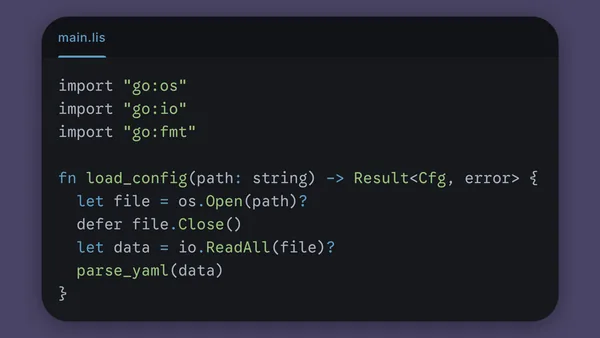
Lisette, available at github.com/ivov/lisette, merges Rust-like syntax—including algebraic data types, pattern matching, and a Hindley-Milner type system—with Go's runtime, enforcing immutability by default and eliminating nil to catch common runtime errors at compile time while ensuring full interoperability with Go's ecosystem.

General / unmitigatedrisk.com

Why Nobody Can Verify What Booted Your Server

TPM-measured boot generates combinatorial PCR values (e.g., PCRs 0,4,8,9,11,12) via irreversible hash chains, but no public registry exists due to non-determinism acknowledged by the TCG. UEFI event logs provide detailed measurements but are often opaque, hindering fleet-wide verification for compliance and remote attestation in cloud VMs.

General / jpmens.net

SSH certificates: the better SSH experience

SSH's Trust on First Use (TOFU) and public key authentication require manual known_hosts management and falter when host keys change. SSH certificates, issued by a Certification Authority (CA), centralize trust for large-scale deployments, automating verification and eliminating per-host key distribution. This enhances security and reduces operational overhead in environments with numerous servers.

General / johns.codes

Making a Type Checker/LSP for Nix

Tix is a fast type checker and LSP for Nix, based on Simple Sub and Negation types, completing full nixpkgs checks in ~20 seconds. It offers autocompletion, jump-to-definition, and type errors, competing with other Nix LSPs like Nil and Nixd. By extending Hindley-Milner with subtyping, it naturally handles union types for Nix's attrset-heavy syntax.

Swift 6.3 Stabilizes Android SDK, Extends C Interop, and More
Languages / infoq.com

Swift 6.3 Stabilizes Android SDK, Extends C Interop, and More

Swift 6.3 stabilizes the Android SDK for native development, introduces the @c attribute for automatic C header generation, and adds module selectors to disambiguate cross-module calls. It includes weak let for concurrency-safe weak references, @specialize and @inline(always) for compiler optimization control, and advances Embedded Swift with unified linking and Swift SMMIO for memory-mapped I/O.

Digital Experience Monitoring belongs in the modern developer workflow
DevTools / thenewstack.io

Digital Experience Monitoring belongs in the modern developer workflow

Digital Experience Monitoring (DEM) integrates Core Web Vitals and synthetic user journeys to correlate frontend errors with backend traces, enhancing debugging and regression detection. It supports deployment strategies like canary releases and feature flags, allowing teams to validate user experience continuously and mitigate risks during incremental rollouts. DEM provides context on which production issues impact critical workflows, essential for modern developer ownership of user outcomes.