Skip to content

Four Signals

Agentic insights for modern tech teams

Presentation: AI Agents to Make Sense of Data at OpenAI
AI/ML / infoq.com

Presentation: AI Agents to Make Sense of Data at OpenAI

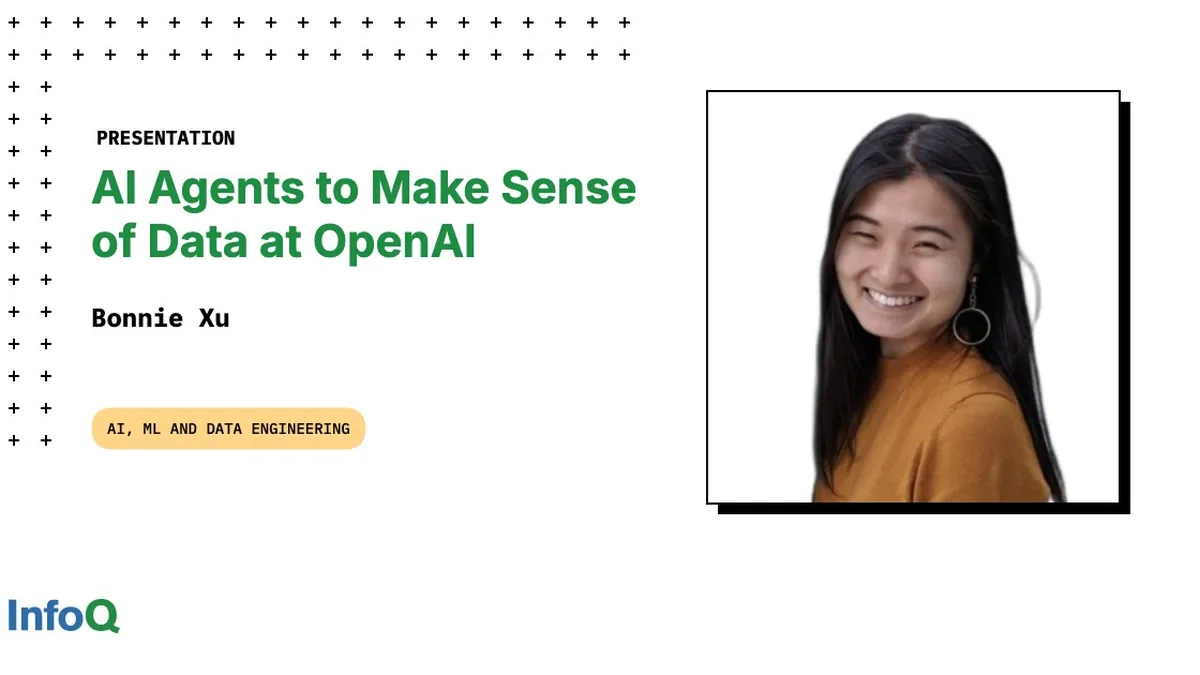
OpenAI's Kepler agent queries 600+ petabytes across 70k datasets, serving 80% of the company. It overcomes context limits via MCP, automated code crawling, and RAG, while using scoped semantic memory for self-learning and AST-based LLM grading for robust, regression-free evaluation.

Why it matters

For a solutions architect focused on AI agent orchestration and data engineering, this demonstrates a production-grade agent handling massive scale with memory and evaluation strategies that prevent regression.

Claude Fable 5 on Bedrock Requires Sharing Inference Data with Anthropic
AI/ML / infoq.com

Claude Fable 5 on Bedrock Requires Sharing Inference Data with Anthropic

Anthropic's Claude Fable 5 and Mythos 5 on Amazon Bedrock require opting into provider_data_share, sending prompts and outputs to Anthropic for 30-day retention with human review—a break from prior models where inference data stayed within AWS's boundary. This policy, dictated by Anthropic not AWS, forces regulated organizations to update DPAs, sub-processor lists, and address CLOUD Act exposure for EU entities, while healthcare teams face BAA gaps. The change undermines Bedrock's core value proposition of neutral data residency, drawing sharp criticism from security researchers and practitioners.

Behind the Scenes:  Block 450 JVM Repositories Into Monorepo to Reduce Dependency Drift
DevTools / infoq.com

Behind the Scenes: Block 450 JVM Repositories Into Monorepo to Reduce Dependency Drift

Block (Cash App/Square) consolidated 450 JVM repositories into a monorepo to eliminate dependency version drift and diamond dependency issues, enabling atomic cross-service commits. The monorepo now supports 8,800 weekly builds with p90 CI under 10 minutes via dependency graph-based build scoping and a custom IntelliJ plugin that loads only relevant projects. This migration replaced polyrepo coordination overhead with a unified codebase, merge queues, and shared Gradle plugins.

Compile Zod (30x faster Zod validation)
General / dev.to

Compile Zod (30x faster Zod validation)

Zod's runtime validation suffers from two performance bottlenecks: schema initialization (solved by hoisting) and tree-walking interpretation that allocates per-node payloads on every call. A new compile-time approach generates exact validator code at build time, eliminating runtime dispatch and allocation, achieving up to 30x faster validation compared to Zod's interpreted path. This contrasts with Zod v4's lazy JIT compilation, which still incurs runtime overhead and is blocked under strict Content-Security-Policy headers.

I Benchmarked 17 Image Conversions on My Production Server. Some Results Were Not What I Expected.
DevTools / dev.to

I Benchmarked 17 Image Conversions on My Production Server. Some Results Were Not What I Expected.

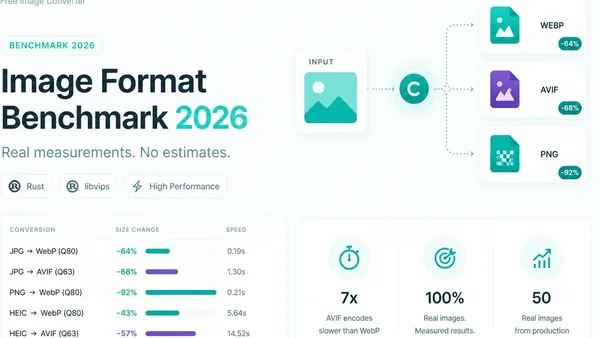
A production benchmark of 17 image conversions using Rust and libvips on 50 real images reveals counterintuitive results: HEIC to JPG increases file size by 14%, AVIF Q63 is 7x slower than WebP Q80 for only 10% better compression (55 KB vs 61 KB), and PNG at 600 DPI can be smaller than at 300 DPI due to smoother gradients. The author recommends WebP Q80 as default (64% smaller than JPG, fast encode) and advises against converting HEIC to JPG; for batch pipelines, AVIF's 7x speed penalty may be prohibitive. Data measured on Convertify's production server using Rust and libvips.

He made your free video player run smoothly. Now he’s doing that for robots.
DevTools / techcrunch.com

He made your free video player run smoothly. Now he’s doing that for robots.

Jean-Baptiste Kempf, creator of VLC Media Player (6B+ downloads), founded Kyber to build an open-source infrastructure layer for real-time remote control of robots, drones, and devices. Its SDK synchronizes video, audio, sensor data, and control inputs with minimal latency, addressing the scale challenge of managing millions of devices. The Paris-based startup raised $5M from Lightspeed (backers of Anthropic and Mistral AI) and is already deployed in defense, telco, robotics, and remote IT access.

AI Model Failover Drills: Keep Agents Useful When Providers Break
AI/ML / dev.to

AI Model Failover Drills: Keep Agents Useful When Providers Break

AI model failover drills must go beyond simple retry chains because providers can fail subtly—returning valid JSON with different field meanings, ignoring tool policies, or dropping citations. The article recommends defining a fallback contract (input/output shapes, quality gates) and running planned tests using golden tasks and fake provider adapters to verify schema preservation, honest degradation, and budget compliance. Prioritize customer-facing workflows like chat, RAG, and tool-calling agents where wrong answers are worse than no answer.

Checkmarx’s new SAST engine isn’t about the LLM. It’s about what happens after.
AI/ML / thenewstack.io

Checkmarx’s new SAST engine isn’t about the LLM. It’s about what happens after.

Checkmarx's new SAST engine orchestrates a deterministic rules scanner, an LLM fine-tuned on security data, and a Findings Analysis Engine (FAE) that classifies true/false positives before results reach developers. The company claims an F1 score of 0.499 (vs 0.20 average) and found 327 true positives missed by a leading frontier model across four production codebases. The orchestration layer, not the LLM itself, is the differentiator, addressing noise from AI-generated code that has increased commit volume by 1-1.5x.

agentic experience for Go
AI/ML / dev.to

agentic experience for Go

The article introduces ax-go, a Go package that standardizes CLI patterns for agentic use, born from the author's distributed tracing lessons and struggles with agent-unfriendly table outputs. It enforces stdout for structured data only, stderr for logs, W3C trace context propagation across gRPC boundaries, deterministic byte-identical output for agent diffing, a __schema command (with MCP adapter) for self-description, and safety primitives like idempotency keys and dry-run. Currently v0.1.0 with golden tests freezing output contracts, it integrates zerolog and OpenTelemetry, aiming to make CLIs as reliable for AI agents as for humans.

Project Valhalla, Explained: How a Decade of Work Arrives in JDK 28
AI/ML / jvm-weekly.com

Project Valhalla, Explained: How a Decade of Work Arrives in JDK 28

Oracle's Lois Foltan confirmed JEP 401 (Value Classes and Objects) will land in JDK 28 as a preview, adding 197k lines across 1,816 files. The feature enables dense memory layouts that avoid pointer indirection and object headers, improving cache utilization. Brian Goetz noted this is only the first part of Valhalla, preempting criticism that the most important parts remain.