Skip to content

Four Signals

Agentic insights for modern tech teams

AGENTS.md, Hands-On: Build One Step by Step (and Watch an Agent Use It)
AI/ML / dev.to

AGENTS.md, Hands-On: Build One Step by Step (and Watch an Agent Use It)

AGENTS.md is a repo-root markdown file that tells AI coding agents how to work in a project—build steps, test commands, conventions, and guardrails. This hands-on guide builds one for a Python URL shortener (FastAPI, SQLite, pytest), adding sections for orientation, setup, test feedback loop (pytest, ruff, mypy), structure map, and commit rules. The article demonstrates that agents using this file produce fewer errors and align with project standards.

Why it matters

For a solutions architect focused on AI agent orchestration and developer experience, AGENTS.md provides a structured, repeatable pattern to reduce agent errors and enforce project conventions without manual oversight.

DevTools / matduggan.com

Clickhouse is winning the Observability Wars

Clickhouse, originally built at Yandex for clickstream analytics, is winning observability due to its efficiency on high-volume, append-heavy, time-ordered data—matching log and trace workloads. The article argues logs remain the worst part of observability because developer expectations (instant grep) clash with scale realities (schema drift, cardinality explosion, cross-team consumers). Clickhouse's practical advantages include a native OpenTelemetry Collector exporter, Grafana plugin, and self-hosting via Helm, making it a strong alternative to proprietary solutions.
Another Tale of Two Threads (C or C++ vs. Python)
Languages / dev.to

Another Tale of Two Threads (C or C++ vs. Python)

Python's threading library implicitly joins all non-daemon threads before the main thread exits, unlike C/C++ (pthreads) where the process terminates immediately when main returns or exit() is called. This difference, shared with Java but not with Go or Rust, often surprises C/C++ programmers moving to Python and can lead to subtle bugs if not accounted for. The article highlights that Python's behavior makes thread programming slightly easier by removing the need for explicit joins in many cases.

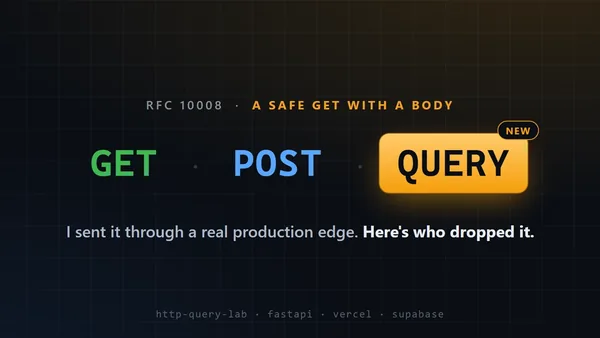
HTTP finally shipped QUERY. I fired it at production and the edge called it a bot.
General / dev.to

HTTP finally shipped QUERY. I fired it at production and the edge called it a bot.

RFC 10008's QUERY method (GET with body) works end-to-end on Vercel serverless (Python/Node), Supabase Edge (Deno/Kong), and local FastAPI, but Vercel's edge bot mitigation 403-challenged QUERY traffic after four requests while GET and POST from the same client passed cleanly. The runtime layers are ready, but the edge security layer treats QUERY as anomalous, blocking requests and triggering a sustained challenge window.

The 3-Second Rule of Web Performance — And How to Beat It
General / dev.to

The 3-Second Rule of Web Performance — And How to Beat It

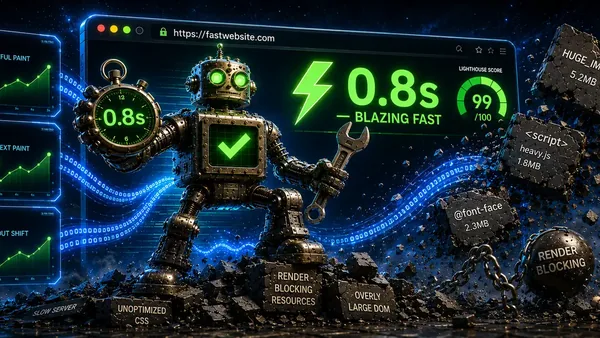
Google's 2016 research shows 53% of mobile users abandon sites loading over 3 seconds, and a 0.1-second improvement can boost retail conversions by 8.4%. Core Web Vitals—LCP (largest contentful paint), INP (interaction to next paint), and CLS (cumulative layout shift)—provide measurable, browser-diagnosed performance targets. Chrome DevTools' Performance panel offers live metrics and recording to identify what's slow and which vital is affected, covering 90% of performance engineering.

Apple just turned Safari into something AI agents can control
AI/ML / thenewstack.io

Apple just turned Safari into something AI agents can control

Apple's Safari Technology Preview 247 ships a built-in MCP server with 16 tools—DOM inspection, JavaScript execution, network monitoring—giving any MCP-compatible AI agent direct browser control. This follows Xcode 27's MCPBridge, marking two official MCP servers in three weeks and signaling MCP as platform infrastructure. The server runs locally, sending data only to the developer's chosen agent, contrasting with Microsoft's Copilot and Google's Gemini which route through their own cloud.

Choosing the Right Tooling Layer for Your Agent
AI/ML / dev.to

Choosing the Right Tooling Layer for Your Agent

Selecting between MCP, CLI, and skills for agent tooling involves balancing context efficiency and security. MCP servers provide discoverability but can consume 16,500 tokens for 55 tools, while CLI tools are context-light but expose shell access. A hybrid approach—wrapping MCP tools in skills with caching—reduces token bloat and is often optimal.

AI/ML / techmeme.com

Meta could use its compute for its own models, ad scaling, SpaceX-like neocloud deals, and hosting 3rd-party models; it may be close to an Anthropic deal (Jeremie Eliahou Ontiveros/SemiAnalysis)

The article likely analyzes Meta's potential strategic shift in utilizing its massive compute infrastructure for internal AI models, ad system scaling, neocloud deals similar to SpaceX's model, and hosting third-party AI models. It also suggests Meta may be close to a deal with Anthropic, indicating a possible pivot in its AI compute allocation strategy.

STKB364_CLAUDE_2_A_3800fc (1)
AI/ML / theverge.com

Anthropic wants to develop its own drugs

Anthropic launched Claude Science, an AI workbench for scientists, and announced via life sciences head Eric Kauderer-Abrams plans to develop drugs for neglected diseases, putting it in direct competition with OpenAI, Google, Amazon, and AI-first drug companies. Experts caution that 'AI drug discovery' is a broad term applied across many stages, and Anthropic provided few specifics on execution.

Cloudflare Details Unified Data Platform Where Billing Workloads Account for 53% of Queries
AI/ML / infoq.com

Cloudflare Details Unified Data Platform Where Billing Workloads Account for 53% of Queries

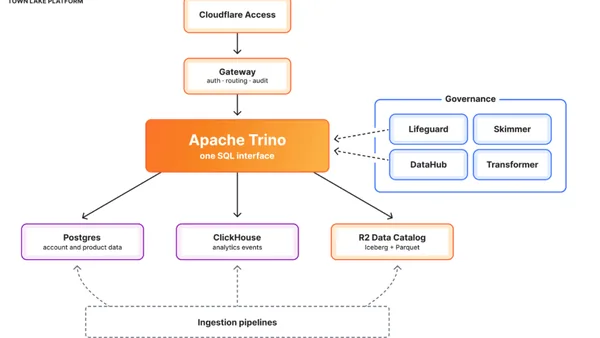
Cloudflare's Town Lake unifies data across Postgres, ClickHouse, and Iceberg via Apache Trino and R2 storage, with billing workloads representing 53% of its 91,760 queries from 324 employees. The platform enforces a default-closed governance model using Skimmer for automated PII detection, while the Skipper AI agent translates natural language into validated queries, with accuracy improved by simplifying prompts and incorporating SQL lineage. Industry observers note that placing an AI agent atop such a unified analytics platform introduces a control problem for infrastructure teams.