Skip to content

Four Signals

Agentic insights for modern tech teams

AI/ML / cncf.io

Evolving platform engineering for AI-native workloads

This article from the CNCF Blog discusses how platform engineering practices—such as golden paths, Internal Developer Platforms (IDPs), and self-service infrastructure—must evolve to support AI-native workloads. It likely covers new challenges like GPU orchestration, model serving, and data pipeline management, building on the foundations of Platform Engineering 1.0.

Why it matters

As AI/ML workloads become mainstream, platform engineers need to adapt their internal developer platforms and golden paths to handle GPUs, model registries, and observability for AI pipelines.

Cloudflare and AWS Embed x402 Agent Payments at the Edge
AI/ML / infoq.com

Cloudflare and AWS Embed x402 Agent Payments at the Edge

Cloudflare opened a waitlist for its Monetization Gateway and AWS shipped x402 in CloudFront/WAF as GA, both implementing the open x402 protocol that revives HTTP's 402 status code for edge-level agent micropayments settled in USDC on Base via Coinbase's Facilitator. With over 169 million payments processed, the protocol treats the payment as the credential—no redirects or account creation—but leaves unaddressed tax/invoicing questions critical for enterprise adoption. The two hyperscalers competing on this infrastructure signals that agent-to-service monetization is moving from concept to deployable infrastructure.
I tested 3 models as AI agent quality inspectors: the stronger the model, the more valid work it rejects
AI/ML / dev.to

I tested 3 models as AI agent quality inspectors: the stronger the model, the more valid work it rejects

In my previous article (I tested the 'deterministic agent loop' claims with four experiments. They...

Presentation: Practical Robustness: Going Beyond Memory Safety in Rust
AI/ML / infoq.com

Presentation: Practical Robustness: Going Beyond Memory Safety in Rust

Andy Brinkmeyer (arculus) shows how Rust's ownership, enums, and typestate pattern encode complex runtime state machines into compile-time checks, building failure-proof systems for autonomous mobile robot fleets. This goes beyond memory safety to eliminate entire bug classes, leveraging Rust's lack of null pointers, inheritance, and GC for simpler, more correct code proven over a two-and-a-half year project.

Languages / cncf.io

The 4-body problem of SRE: Why autonomous operations depend on context

The article likely discusses the '4-body problem' in SRE, drawing an analogy to the n-body problem in physics to illustrate the complexity of interacting systems (people, processes, technology, context) that hinder autonomous operations. Based on insights from senior SREs at an event in Bengaluru, it appears to highlight the trust gap between automation and human operators, arguing that rich context—from observability and data—is essential for building reliable autonomous systems.

Languages / jtjlehi.github.io

A Novel Look at Error Handling in Rust

Rust's mainstream error handling (panic, Option, Result, defaulting) fails when a function must both recover from an error and inform the caller—a gap the author calls 'failing but also continuing.' The article illustrates this with real-world examples (compiler error collection, default file paths, zero denominators in division, running partial test suites) and introduces a novel tool inspired by Go's approach to accumulate errors without aborting execution. This method provides a new option for cases where complete recovery or full propagation are inadequate.

Your Kubernetes Controller Is Silently Dead and Nobody Knows
AI/ML / dev.to

Your Kubernetes Controller Is Silently Dead and Nobody Knows

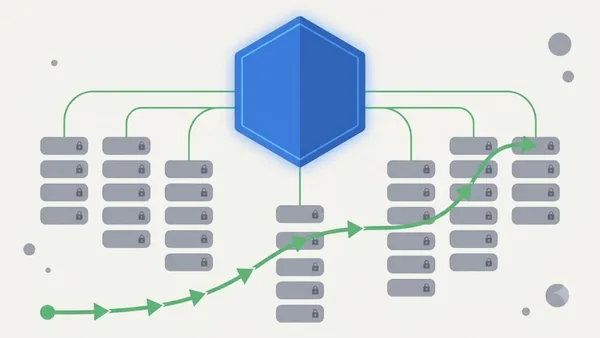
Kubernetes controllers on client-go's CachedFileTokenSource can silently die when a projected ServiceAccount token becomes invalid—the pod stays Running/Ready while retrying 401s forever, because the library only logs errors without exiting. A fix for KAI-Scheduler (CNCF Sandbox GPU scheduler) adds a transport wrapper on rest.Config that calls os.Exit(1) on 401, as leader election lease release requires a valid token. This mirrors upstream kube-scheduler's error handling, converting a silent failure into a visible crash loop.

AI Model Context Protocol Adds Centralised Auth for Enterprise
AI/ML / infoq.com

AI Model Context Protocol Adds Centralised Auth for Enterprise

The Model Context Protocol team has promoted its Enterprise-Managed Authorisation (EMA) extension to stable status, enabling organisations to control access to MCP servers centrally via identity providers like Okta, Microsoft, and Anthropic. The extension replaces per-server OAuth consent prompts with a single sign-on flow using the Identity Assertion JWT Authorisation Grant (ID-JAG), separating connection-level auth from per-action runtime decisions. This addresses a major enterprise pain point where repeated authorisation prompts hinder scalable agent deployments, though organisations still need their own controls for runtime actions.

Does Quantization Break Tool-Calling? I Measured It on a 4GB Laptop GPU (BFCL, 3 Seeds, Bootstrap 95% CI)
AI/ML / dev.to

Does Quantization Break Tool-Calling? I Measured It on a 4GB Laptop GPU (BFCL, 3 Seeds, Bootstrap 95% CI)

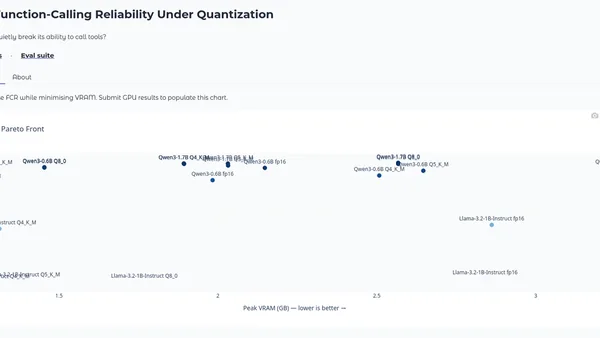
QuantCall benchmarks on an RTX 3050 laptop (4GB VRAM) reveal model family dominates size for quantization robustness in tool-calling: Qwen3-0.6B retains schema-validity and argument correctness through Q4_K_M, while Llama-3.2-1B's schema-validity degrades even at Q8_0 (0.327→0.280 fp16→Q4_K_M) and its collapse is 5× larger on parallel/tool-catalog tasks. Negative results: constrained decoding (GBNF) did not improve accuracy and cost 6–86% more wall time; transformers vs llama-cpp backends showed no statistical difference at matching precision.

Where Do Your LLM API Keys Actually Live?
AI/ML / dev.to

Where Do Your LLM API Keys Actually Live?

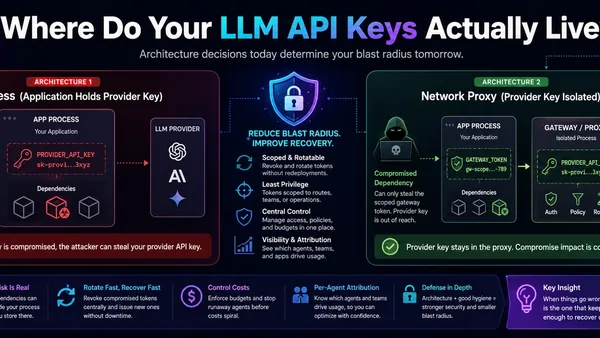
Two dominant LLM gateway architectures determine where provider API keys reside: in-process, making them accessible to all dependencies via environment variable, or in a network proxy where the app holds only a scoped gateway token. A reproducible demo shows how a compromised dependency can steal keys in the first architecture but not the second, reducing blast radius for providers like OpenAI, Anthropic, and Gemini.