Skip to content

Four Signals

Agentic insights for modern tech teams

The bottleneck for AI agents isn’t the model anymore. It’s the context layer.
AI/ML / thenewstack.io

The bottleneck for AI agents isn’t the model anymore. It’s the context layer.

The bottleneck for AI agents has shifted from model capability to the context infrastructure layer. Andrej Karpathy's approach—compiling raw data into a structured wiki with summaries, backlinks, and concept articles via an LLM, then exposing tools as CLIs and feeding outputs back—achieves reliability where smarter models fail. Production teams often skip this explicit compilation step, wiring models directly to raw data, resulting in pattern-matched guesswork over noisy context windows.

Why it matters

For a solutions architect building agent systems, this reframes the engineering priority: invest in context compilation, retrieval, and tool interfaces rather than chasing model upgrades, because the infrastructure around the model determines real-world reliability.

Pinecone Introduces Nexus Engine for Compiling Business Context into Structured Data for AI Agents
AI/ML / infoq.com

Pinecone Introduces Nexus Engine for Compiling Business Context into Structured Data for AI Agents

Pinecone's newly GA Nexus Engine compiles scattered enterprise business context from sources like contracts, wikis, and support tickets into a structured query layer for AI agents, eliminating expensive per-query retrieval. Using workspaces, contexts, and manifests, domain experts define schemas upfront, and agents query via KnowQL—yielding 9–15× token reduction, 90% accuracy in data management (vs. 65% RAG), and perfect task completion in legal research vs. 6% for a coding agent. Built-in connectors support local files, Box, and OneLake, with Google Drive, Slack, GitHub, and S3 coming soon, along with BYOC deployment for compliance.
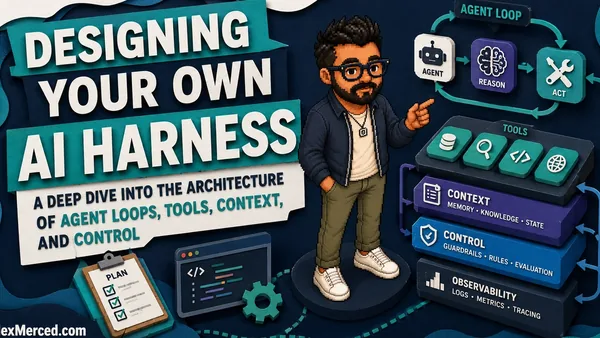
Designing Your Own AI Harness: A Deep Dive Into the Architecture of Agent Loops, Tools, Context, and Control
AI/ML / dev.to

Designing Your Own AI Harness: A Deep Dive Into the Architecture of Agent Loops, Tools, Context, and Control

A major framework team boosted an agent benchmark from the low 50s to mid 60s, vaulting into the top five, by rebuilding only the harness around the same model. The harness is a while-loop with judgment: assembling context, sending to the model with tool schemas, validating permitted tool calls, and enforcing budgets; the article decomposes this into five layers (tools, context, permissions, control, persistence) with patterns like progressive context compaction and filesystem-first tools to combat context rot.

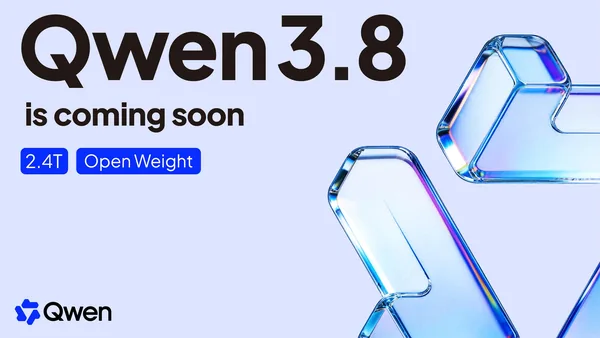
Qwen3.8 is launching and going open-weight soon
General / twitter.com

Qwen3.8 is launching and going open-weight soon

Appears to announce the upcoming release of Qwen3.8, a massive open-weight AI model with 2.4 trillion parameters from Alibaba's Qwen team. The excerpt claims it is one of the most powerful models available, second only to an unspecified frontier model (misidentified as 'Fable 5'), and emphasizes its continuous evolution and open-weight availability.

The Kimi K3 Moment
General / stephen.bochinski.dev

The Kimi K3 Moment

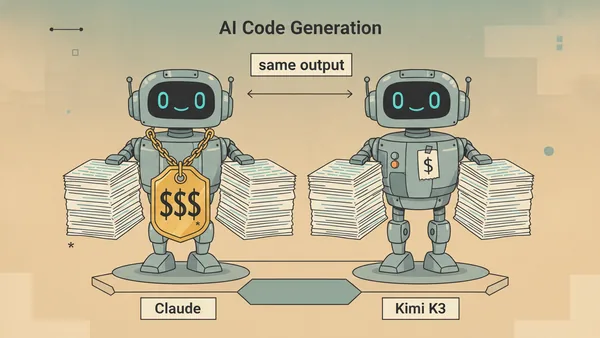
China's Kimi K3 matches Claude's coding output quality while costing 70% less per token and offering uncapped plans at $39/month—no fine-print fallback to a weaker model. The open-source GLM 5.2 further beats Claude on cyber benchmarks by actually performing restricted tasks, exposing the failure of US AI policy that constrains American customers while frontier-quality open models thrive abroad. As restricted US models like Claude lose capability, engineers should evaluate K3 and GLM 5.2 as viable, unrestricted replacements for agentic coding work.

Platform engineering’s new job: serving environments at agent speed
AI/ML / thenewstack.io

Platform engineering’s new job: serving environments at agent speed

Platform engineering has reached mainstream adoption (90% of organizations have an internal platform), but the surge of AI coding agents—which generate hundreds of bursty, concurrent, short-lived environment requests per day—is breaking conventional provisioning models. Both full-copy duplication (costly and slow) and shared staging environments (queuing under Little's Law) fail under agent traffic; the discipline must shift from provisioning to serving environments as API-like traffic, as 94% of organizations now deem AI critical to platform evolution.

Deterministic Data Engineering With AI Harnesses: Using Claude Code, Codex, Antigravity, and OpenCode for Data Work You Can Actually Trust
AI/ML / dev.to

Deterministic Data Engineering With AI Harnesses: Using Claude Code, Codex, Antigravity, and OpenCode for Data Work You Can Actually Trust

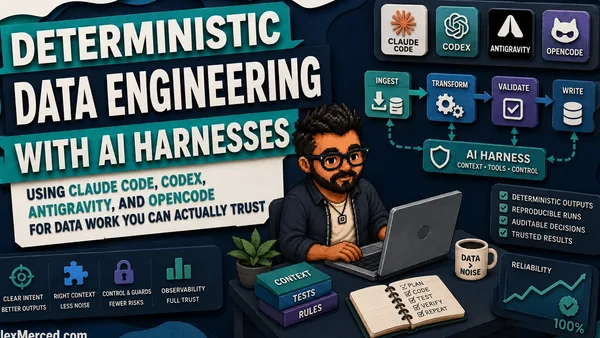
AI coding harnesses such as Claude Code, OpenAI's Codex, Google's Antigravity, and OpenCode enable deterministic data engineering when used to author artifacts (e.g., SQL, dbt models, pipeline scripts) at development time rather than at runtime. The artifact-first principle routes model output through version control, CI, and code review, making the executed pipeline as deterministic as hand-written code. Techniques like tests-as-contracts, dry-run gates, schema pinning, and golden datasets ensure reproducibility, while the determinism ladder operationalizes trust in agent-assisted data work.

Architecting lean LLM caching: how to drop a 20M-row table without losing your AI memory
AI/ML / dev.to

Architecting lean LLM caching: how to drop a 20M-row table without losing your AI memory

For an agentic pipeline reloading 20M rows every two weeks, only 60k distinct inputs reach the LLM, allowing a tiny cache table (enrichment_cache) to survive the wipe of the main working table (data), dropping from 16GB to a few MB. The four-step process—wipe, load, propagate cache hits via SQL UPDATE, then query LLM only for misses—keeps the cache durable in Postgres without needing Redis. However, batch UPDATE across 20M rows triggers Postgres MVCC bloat, so the team adopted a CTAS-and-swap zero-bloat pattern (detailed in part 3).

Google's AlphaEvolve Reaches General Availability with Evolutionary Code Optimization as a Service
AI/ML / infoq.com

Google's AlphaEvolve Reaches General Availability with Evolutionary Code Optimization as a Service

Google's AlphaEvolve reached GA as an evolutionary code optimization service on the Gemini Enterprise Agent Platform, extending DeepMind's matrix multiplication research to any codebase. It uses Gemini models to generate mutated candidate programs that users score client-side on their own infrastructure, following a four-step workflow from baseline seed to production deploy. Customer results include Klarna doubling ML throughput (6,000 candidates over three weeks), JetBrains improving IDE completion latency by 15-20%, and Google reporting 20% less write amplification in Spanner LSM-tree compaction—but the approach only works where problems have measurable evaluation functions.

I trust Claude for everything. This test made me rethink that.
AI/ML / thenewstack.io

I trust Claude for everything. This test made me rethink that.

xAI's Grok 4.5 claims to match Anthropic's Claude Opus 4.8 on coding while using 4.2x fewer output tokens and costing significantly less ($2/$6 vs $5/$25 per million tokens). In a head-to-head test on three Rust tasks in the fd repo, both models produced identical bug fixes, but Grok used 4.3x fewer tokens. However, on the harder SWE-Bench Pro, Opus still outperforms Grok, so the claim is 'as good for far less' rather than superior.