Skip to content

Four Signals

Agentic insights for modern tech teams

A $500 RL fine-tune of a 9B open model beat frontier models on catalog review
AI/ML / fermisense.com

A $500 RL fine-tune of a 9B open model beat frontier models on catalog review

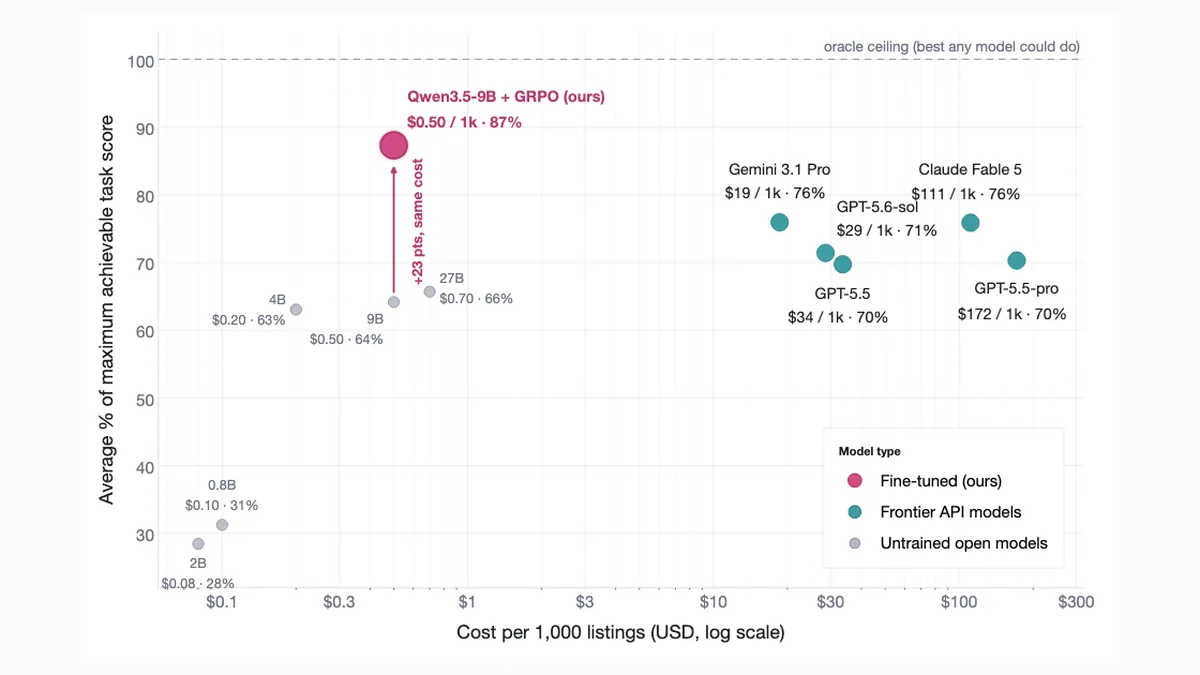
A GRPO fine-tuned 9B open-source model achieved 40-340× cost reduction over frontier models on a catalog-review task, scoring $0.50 per 1,000 listings while outperforming all tested configurations. The article argues that AI-first companies redesign workflows rather than drop models into existing processes, citing McKinsey data showing workflow redesign is the top correlate with EBIT impact yet only 21% of organizations have done it. It also emphasizes incentivizing experimentation, providing tailored business context via retrieval, and measuring usage with scored evaluations to avoid the CFO question.

Why it matters

For a platform engineer evaluating AI integration, this demonstrates that fine-tuning smaller open models with RL can beat expensive APIs on specific workflows, and that process redesign is the critical success factor—not just model selection.

Can Google ADK Talk to Microsoft Foundry on Azure? A Cross-Cloud A2A Benchmark
Cloud / dev.to

Can Google ADK Talk to Microsoft Foundry on Azure? A Cross-Cloud A2A Benchmark

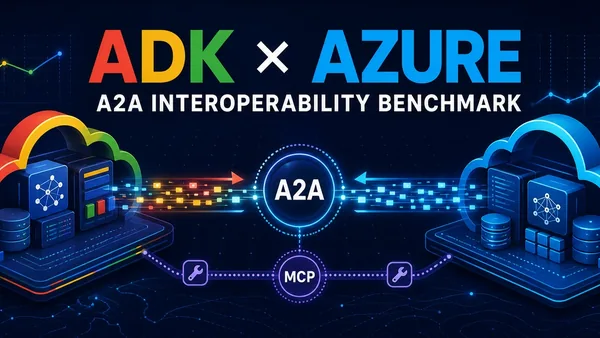
A cross-cloud benchmark demonstrates that a Microsoft Agent Framework coordinator hosted on Azure Foundry can successfully invoke a Google ADK agent on Cloud Run via A2A v1.0, with no framework-specific glue. The test measures three modes—MCP-only, A2A-only, and verified—revealing that protocol-version skew (A2A v0.3.0 vs v1.0) caused initial failures due to lack of negotiation, and that independent verification over A2A adds measurable latency but improves correctness when both clouds agree on the same Frankfurter API data. The project uses a domain layer of framework-independent Python with pydantic models and Decimal for math, avoiding LLM arithmetic entirely.

Sandboxing Patterns for Local AI Agents With Filesystem Access
AI/ML / dev.to

Sandboxing Patterns for Local AI Agents With Filesystem Access

Local AI agents with filesystem access pose risks from confident mistakes, not malice. Key sandboxing patterns include allowlisting only specific root directories (canonicalized to prevent path traversal), denying dotfiles and secrets by default even inside allowed roots, implementing dry-run modes that show unified diffs before writes, and using read-only bind mounts for reference material. These patterns mirror smart contract security thinking applied to agent tooling.

Cloudflare open-sources a debugger for privacy protocols used by Apple and Microsoft, with AI agents in mind
AI/ML / thenewstack.io

Cloudflare open-sources a debugger for privacy protocols used by Apple and Microsoft, with AI agents in mind

Cloudflare open-sourced pvcli, a command-line debugger for Oblivious HTTP (OHTTP) and MASQUE protocols, under Apache 2.0. The tool addresses the inherent debugging difficulty in split-trust privacy systems like Apple's iCloud Private Relay and Microsoft's Edge Secure Network, where no single operator can see both client identity and destination. By providing a ready-made debugging interface, pvcli lowers the barrier for smaller teams to adopt privacy-preserving architectures without deep protocol expertise or custom tooling.

Satya Nadella says companies that trust one AI for everything may not survive
AI/ML / techcrunch.com

Satya Nadella says companies that trust one AI for everything may not survive

Microsoft CEO Satya Nadella warns that enterprises relying on a single proprietary AI model risk extinction, urging them to decouple model usage from data and prompts via AI gateways. He advocates retaining all metadata to eventually train custom or open-weight models, citing risks of vendor lock-in and model makers copying business logic. Despite Microsoft's investments in Anthropic and OpenAI, Nadella promotes multi-model orchestration and separate coding harnesses (e.g., avoiding Claude Code or ChatGPT Codex) to maintain control.

How is the Bun Rewrite in Rust Going?
Languages / lockwood.dev

How is the Bun Rewrite in Rust Going?

An analysis of Bun's claimed rewrite from Zig to Rust using Anthropic's Claude reveals the project has no release tag 11 weeks post-merge, 2,475 open PRs from robobun, and a CI/CD backlog estimated at 86 days of continuous pipeline runs. The $165,000 API cost over 11 days excludes Buildkite infrastructure and Anthropic employee involvement, suggesting the true cost and timeline are significantly higher than Jarred Summner's blog post implied.

How Cursor + BrowserAct Handles Dynamic Pages Without Brittle Selectors
General / dev.to

How Cursor + BrowserAct Handles Dynamic Pages Without Brittle Selectors

BrowserAct CLI integrates with Cursor to give AI agents an inspect → act → reassess loop that adapts to dynamic DOM changes, eliminating reliance on brittle selectors that break after frontend updates. Instead of assuming page structure, the agent reads the current browser state before each action, making automation resilient to hydration changes, re-renders, and attribute shifts. The approach uses a compact state representation rather than cached DOM snapshots, enabling reliable testing on modern web applications without maintaining selector-based tests.

I Had a Lot of Fun Building a Linux Packet Flight Recorder
DevTools / dev.to

I Had a Lot of Fun Building a Linux Packet Flight Recorder

skbx is a Linux packet-path flight recorder built with Rust and CO-RE eBPF that captures kernel networking function observations into an append-only JSONL stream for replay without root. It tracks sk_buff journeys through namespaces, routing, Netfilter, XDP, TC, tunnels, clones, and drop reasons, explicitly inspired by pwru but focused on post-incident evidence with stable event handles and reliability counters. The tool requires Rust 1.85+, Clang/LLVM with BPF backend, and a kernel exposing BTF, installing via `cargo install --git https://github.com/copyleftdev/skbx --locked skbx-cli`.

Podcast: Rethinking Data: Moving From the Traditional Three-Tier Web Stack to Client-Side Event Sourcing
DevTools / infoq.com

Podcast: Rethinking Data: Moving From the Traditional Three-Tier Web Stack to Client-Side Event Sourcing

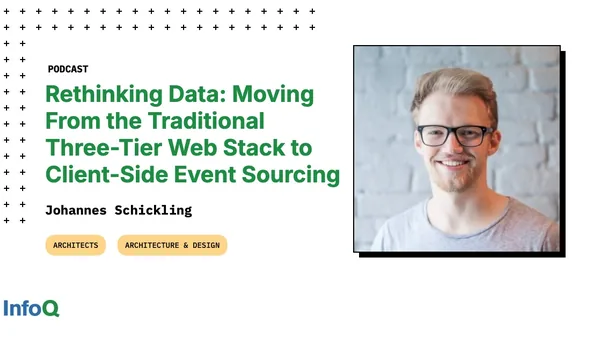
Johannes Schickling, founder of Prisma, discusses his shift from server-side database tooling to local-first architectures, using his music curation app Overtone as a case study. He advocates for client-side event sourcing with SQLite to overcome server data bottlenecks, contrasting it with CRDTs for collaborative conflict resolution. The podcast emphasizes that local-first requires breaking down monolithic data structures and careful assessment of whether offline capability and data ownership justify the added complexity.

[Learning Notes][Golang] Authorization Challenges in the AI Agent Era: What is ID-JAG and Why I Re-implemented It in Go
AI/ML / dev.to

[Learning Notes][Golang] Authorization Challenges in the AI Agent Era: What is ID-JAG and Why I Re-implemented It in Go

ID-JAG (Identity Assertion JWT Authorization Grant) is an emerging IETF draft authorization mechanism that lets AI agents act on behalf of users with scoped, short-lived tokens, preventing the risks of shared master keys or leaked user sessions. Built on OAuth2 token exchange (RFC 8693), it consolidates authorization at SSO login so agents can exchange identity assertions for new tokens without repeated user prompts. The author re-implemented the MCP server in Go to demonstrate the flow, including downscoping permissions at each hop to enforce least privilege.