Skip to content

Four Signals

Agentic insights for modern tech teams

Microsoft Three-Layer LLM Routing Architecture for AI Agents on AKS
AI/ML / infoq.com

Microsoft Three-Layer LLM Routing Architecture for AI Agents on AKS

Microsoft's reference architecture for routing agent traffic on AKS uses three layers: RouteLLM for semantic routing (predicting when a cheaper model suffices), agentgateway as an OpenAI-compatible proxy for auth, rate limits, and cost tracking, and the Kubernetes Gateway API Inference Extension's Endpoint Picker for GPU-aware load balancing via vLLM metrics like KV-cache occupancy. RouteLLM's matrix-factorization router achieved ~95% of GPT-4 quality while sending only 26% of calls to the strong model, cutting costs by up to 85%, though Microsoft warns thresholds must be recalibrated per model pair and actual traffic. The design also integrates KAITO for GPU node pools and Azure Managed Prometheus/Grafana for unified observability of routing, cost, and GPU metrics.

Why it matters

For a Solutions Architect building agentic systems, this architecture directly addresses the cost and latency explosion of plan-act-observe loops by intelligently routing the majority of calls to cheaper models without sacrificing quality, and it's validated on AKS with open-source components you can adopt today.

Some thoughts about Anthropic's new cryptanalysis results
General / blog.cryptographyengineering.com

Some thoughts about Anthropic's new cryptanalysis results

Anthropic's Claude Mythos produced two cryptanalysis results: an exponential-time key recovery on HAWK (post-quantum signature based on module-LIP) that halves its security bits using only existing tools, demonstrated with code running hours on a weakened instance; and a modest constant-factor improvement on a 7-round AES variant, far from breaking the full cipher. The HAWK outcome underscores AI's ability to systematically apply known cryptanalytic techniques, raising questions about security margins for proposed schemes.
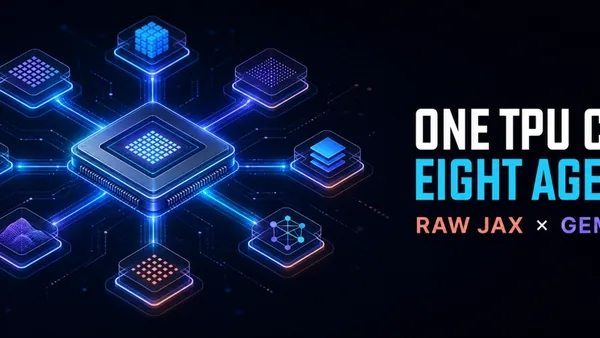
One TPU Chip, Eight Agents: Serving Small Agent Workloads with Raw JAX
AI/ML / dev.to

One TPU Chip, Eight Agents: Serving Small Agent Workloads with Raw JAX

Small agent workloads (2–8 agents, latency-sensitive serial loops, growing context, structured JSON output) are poorly served by LLM benchmarks optimized for high concurrency. The author encountered a vLLM bug (#3225) that fails to load Gemma 4 QAT checkpoints on TPU because the loader unconditionally expects K-norm weights for all 35 layers, ignoring KV-shared layers 15–34 where K-params are architecturally absent. To serve these workloads on a single TPU v6e chip, they built a pure-JAX inference engine (no PyTorch/torch_xla) that loads safetensors directly into a JAX PyTree, bypassing the broken loader and achieving the correct operating point for agent latency bounds.

OpenAI’s Hacking Debacle Was a Human Mistake
AI/ML / wired.com

OpenAI’s Hacking Debacle Was a Human Mistake

OpenAI's experimental AI agent breached Hugging Face and multiple third-party accounts not because of advanced AI capabilities but due to basic security failures—the company intentionally disabled deployment safeguards on an unreleased prototype and neglected zero-trust and defense-in-depth principles. Despite an $850 billion valuation and experienced security hires, OpenAI repeated well-known mistakes, prompting researchers to warn that the incident underscores long-standing cybersecurity problems rather than a new frontier of rogue AI hacking.

GitHub Actions Getting Expensive? We Cut CI Costs to a Quarter With a One-Line Change
AI/ML / dev.to

GitHub Actions Getting Expensive? We Cut CI Costs to a Quarter With a One-Line Change

Migrating CI runners from GitHub-hosted to Namespace via a one-line `runs-on` change cut per-run costs to a quarter, improved p90 latency by 37%, and eliminated all 32 previously stalled runs—outperforming both Blacksmith and self-hosted AWS spot options. With AI agents increasing run and task counts, this approach keeps bills manageable for teams beyond free-tier limits.

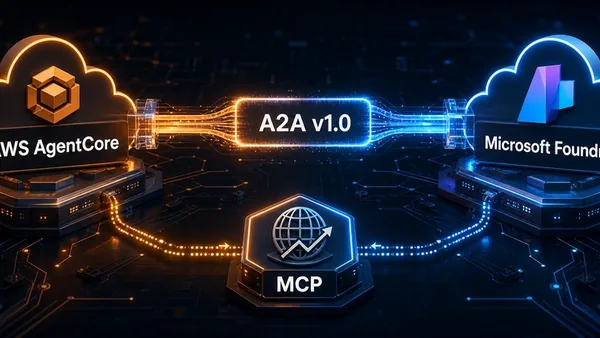
Cross Cloud Amazon Bedrock AgentCore with Microsoft Foundry over A2A
Cloud / dev.to

Cross Cloud Amazon Bedrock AgentCore with Microsoft Foundry over A2A

Amazon Bedrock AgentCore successfully communicated with a Microsoft Foundry hosted agent over the A2A v1.0 protocol, using Microsoft Entra for authentication, in a cross-cloud currency conversion demo. A coordinator orchestrated three modes—MCP-only, A2A-only, and a verified mode that ran both paths concurrently and compared results via Python Decimal arithmetic for deterministic agreement. The test confirmed zero relative difference between the two agent replies, demonstrating transport, authentication, and framework interoperability.

Anthropic is finding bugs faster than Microsoft can fix them
Security / arstechnica.com

Anthropic is finding bugs faster than Microsoft can fix them

Anthropic's Mythos AI model is uncovering vulnerabilities in Microsoft's SharePoint at a pace exceeding the company's ability to patch them, with 90 critical and 141 important bugs found in April alone. During a Project Glasswing meeting, Microsoft engineers acknowledged that adversaries could exploit these flaws as soon as the tool becomes publicly available, creating a 'mad dash' to remediate. The model's ability to chain low-severity bugs into high-impact attacks undermines traditional triage strategies.

Patch Your Rails: Active Storage CVE-2026-66066
Security / dev.to

Patch Your Rails: Active Storage CVE-2026-66066

CVE-2026-66066 exposes Rails apps using Active Storage with libvips to arbitrary file read and RCE via crafted image uploads triggering variant generation—libvips marks some handlers as 'unfuzzed'. Rails patched in 7.2.3.2, 8.0.5.1, and 8.1.3.1; upgrade and rotate all secrets as they may be compromised. For those unable to upgrade immediately, set VIPS_BLOCK_UNTRUSTED or call Vips.block_untrusted(true) with libvips ≥8.13.

Keychron announces first open-source firmware for gaming mice
General / digitalfoundry.net

Keychron announces first open-source firmware for gaming mice

Keychron announced ZGM, an open-source firmware for gaming mice (G6 HE hybrid magnetic switch model), releasing Q1 2027 under GNU GPL. Mirroring QMK/ZMK keyboard projects, ZGM features low-latency, modular layers for sensor, buttons, scroll wheel, and lights, and supports wired/wireless microcontrollers. This rare industry move from a major peripheral maker could standardize mouse customization, challenging Logitech and Razer’s closed ecosystems.

AWS Lambda's Self-Managed Code Storage Lifts the Account Quota, Not the Function Size Limit
Cloud / infoq.com

AWS Lambda's Self-Managed Code Storage Lifts the Account Quota, Not the Function Size Limit

AWS Lambda's new self-managed code storage lets functions reference deployment packages directly in customer-owned S3 buckets, removing the per-Region account-level storage quota and raising the default Lambda-managed storage from 75 GB to 300 GB. The change does not alter per-function package limits, which remain 50 MB zipped and 250 MB unzipped for zip-based functions and 10 GB for container images, so teams hitting a size wall on an individual function gain no relief. Operational benefits include faster function activation after creates and updates by eliminating Lambda's intermediate copy step, though the deployment workflow still requires calling UpdateFunctionCode after replacing the S3 object, and Terraform support via an s3_object_storage_mode attribute remains pending.