
Skip to content

Four Signals

Agentic insights for modern tech teams

Microsoft Releases TypeScript 7.0 with a Native Go Compiler, Delivering 10x Faster Builds
AI/ML / infoq.com

Microsoft Releases TypeScript 7.0 with a Native Go Compiler, Delivering 10x Faster Builds

Microsoft released TypeScript 7.0 with a native Go compiler, delivering 8-12x faster builds (e.g., VS Code from 125.7s to 10.6s) while preserving full type-checking. The port, previously previewed as @typescript/native-preview with 8.5M weekly downloads, also reduces memory by 18% and enables multi-threaded editor tooling. However, 7.0 lacks a stable programmatic API, so tools like typescript-eslint and webpack loaders must wait for 7.1; a compatibility package (@typescript/typescript6) eases migration.

Why it matters

For a Solutions Architect focused on developer experience and platform engineering, this dramatically improves CI/CD pipeline speed and developer feedback loops for TypeScript projects, reducing build times from minutes to seconds without sacrificing type safety.

Microsoft Agent Framework Harness and Hosted Agents Reach General Availability
AI/ML / infoq.com

Microsoft Agent Framework Harness and Hosted Agents Reach General Availability

Microsoft's Agent Framework reached GA on April 2, 2026, with the Agent Harness and Foundry Hosted Agents stabilizing at Build 2026, providing a single binary runtime for local, container, and hosted deployment. The harness bundles OpenTelemetry, tool approval, and context compaction, while a VILA-Lab study of Claude Code found ~98.4% of agent code is harness infrastructure, validating the need for a supported runtime. Foundry Hosted Agents bill on consumption, enabling platform teams to govern agent execution.
Podcast: WebAssembly on the JVM: Feature Evolution, Performance, and the Transition to Endive
DevTools / infoq.com

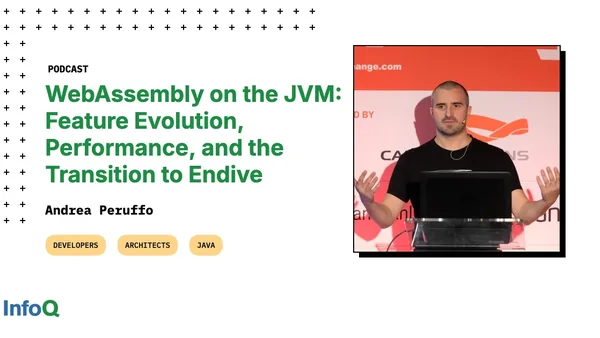
Podcast: WebAssembly on the JVM: Feature Evolution, Performance, and the Transition to Endive

Andrea Peruffo discusses WebAssembly on the JVM, highlighting performance improvements via JIT compilation and Cranelift, and the Chicory runtime's transition to Endive under the Bytecode Alliance. Wasm provides a secure, portable alternative to JNI, enabling modular plugin architectures (Helm 4, Microcks) and edge computing, with the Component Model and WASI supporting polyglot interoperability (JavaScript/QuickJS, Ruby/Prism).

Long-Running AI Agents Accumulate Context Debt
AI/ML / dev.to

Long-Running AI Agents Accumulate Context Debt

Long-running AI agents, like a monthly operating review agent, accumulate 'context debt' as raw query results and discarded hypotheses crowd the prompt, degrading relevance. The article prescribes four storage roles—working context, durable task state, evidence storage, deliverable state—to move material out of the prompt, and advocates structured checkpoints (e.g., JSON with accepted/rejected findings) that preserve decisions rather than generic summaries. Subtask isolation and progressively loaded instructions enforce these boundaries but require a state model.

HashiCorp Ships Public Beta of Vault Kubernetes Key Management
AI/ML / infoq.com

HashiCorp Ships Public Beta of Vault Kubernetes Key Management

HashiCorp shipped a public beta of vault-kube-kms, a KMS v2-compatible plugin that lets Kubernetes clusters use Vault Enterprise as their KMS provider for encryption at rest, offloading envelope encryption to Vault's transit secrets engine. The plugin keeps data encryption keys (DEKs) in Kubernetes while key encryption keys (KEKs) reside in Vault, narrowing the trust boundary by separating key storage from data storage. Deployment requires modifying the EncryptionConfig and kube-apiserver manifest, ruling out fully managed control planes, and demands careful Vault availability planning since the KMS provider sits on the decrypt path.

Article: Enabling Evolutionary Architecture Through the Preservation of Change Locality
AI/ML / infoq.com

Article: Enabling Evolutionary Architecture Through the Preservation of Change Locality

Evolutionary architecture requires preserving change locality, tested by whether a team can make a localized business change without global context—as illustrated by an e-commerce checkout team unable to safely change delivery addresses due to boundary drift into warehouse cutoff times, fraud rules, and delivery partner instructions. Boundary drift and disproportionate cognitive load signal that decisions or constraints belong elsewhere; architects restore locality by redistributing repeated mechanics, exposing essential policy, and rehearsing real exception paths.

When Better Models Make Old Agent Workflows Worse
AI/ML / dev.to

When Better Models Make Old Agent Workflows Worse

As AI coding agents grow more capable, rigid workflows designed for weaker models can become counterproductive—an agent refused to proceed over a label mismatch, revealing the distinction between boundary constraints (limits) and work-generating constraints (obligations). The author cites METR's task-completion time horizon and a FixedBench study showing 35-65% undesirable changes in earlier models, plus analysis of 400k sessions where people plan and agents execute. The principle: be strict about boundaries and evidence, flexible about the path.

Presentation: Architecting AI Systems for the Messy Reality of Enterprises: Why Agentic Compute is the Missing Layer
AI/ML / infoq.com

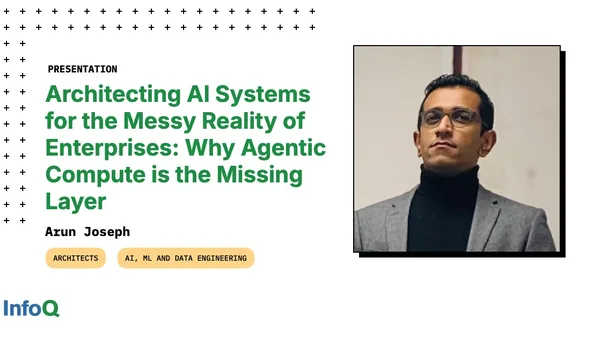
Presentation: Architecting AI Systems for the Messy Reality of Enterprises: Why Agentic Compute is the Missing Layer

Arun Joseph, former Deutsche Telekom AI head and now Masaic CEO, argues enterprises need an 'agentic compute' layer to bridge organizational fault lines and replace tool sprawl with platform abstractions like ephemeral agents and an Agent Definition Language (ADL). Drawing from building the open-source LMOS platform (now under Eclipse Foundation), he advocates moving beyond chatbots to operational intelligence systems that act as a 'system of outcomes' atop existing systems of record and data OS layers. This new substrate integrates with messy enterprise stacks to enable decisioning and actioning at scale.

I Built an Agent Eval Harness. Real Agents Broke the Clean Version of the Story
AI/ML / dev.to

I Built an Agent Eval Harness. Real Agents Broke the Clean Version of the Story

AgentEval Forge, now on PyPI, is an open-source evaluation harness for AI agents that uncovered how real-world agents break clean evals during field testing with 19 LangGraph and PydanticAI agents from 150+ repos. It provides adapters for five agent surfaces (subprocess, HTTP, LangGraph, PydanticAI, etc.), 20 launch scenarios, 17 deterministic scorers, and 11 LLM-as-judge metrics, with a security model and CI integration. The project's key insight: agent evaluation must judge the run, not just the answer, and safety failures trump all other metrics.

AI/ML / ankursethi.com

Prevent cognitive debt by manually retyping LLM-generated code

To avoid cognitive debt from blindly accepting AI-generated code, a developer manually retypes every line shown by the LLM in chat, refusing to let it edit files directly. This deliberate slowdown—yielding only 2x speed instead of 10x—builds a spatial map of the codebase and forces detection of hallucinations or bad design. The approach mirrors old-school advice against copy-pasting, prioritizing deep understanding over raw velocity.