
Skip to content

Four Signals

Agentic insights for modern tech teams

Stop asking your AI agent to follow rules. Enforce them.
AI/ML / dev.to

Stop asking your AI agent to follow rules. Enforce them.

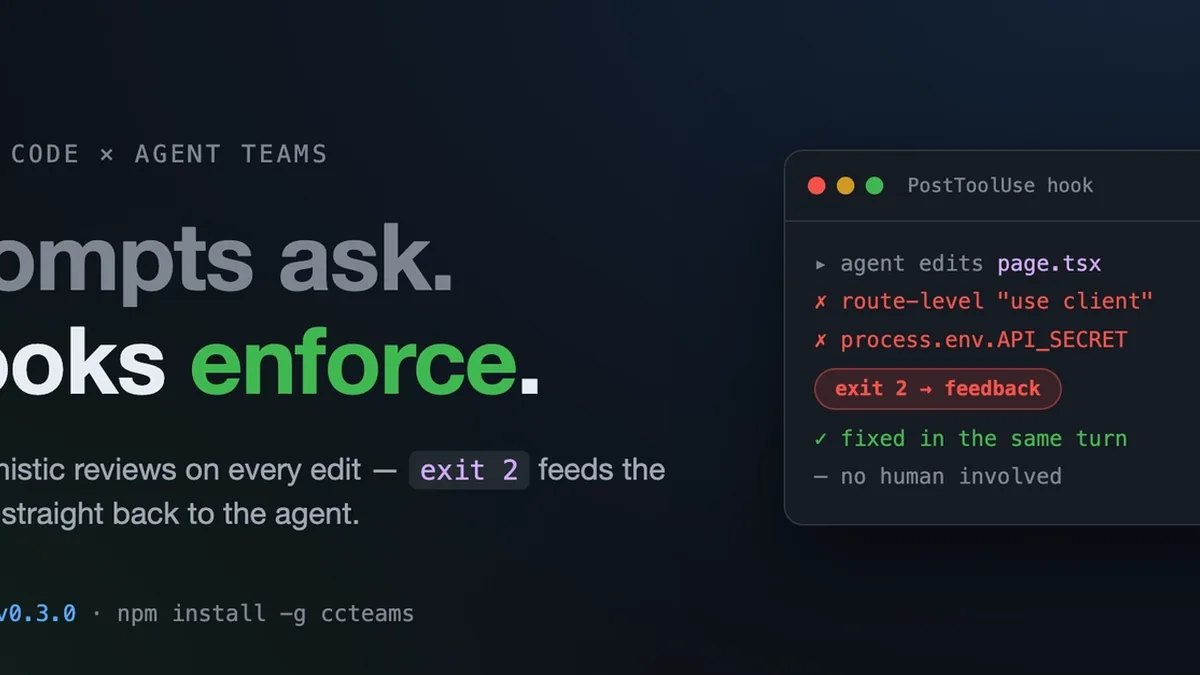
Claude Code hooks with exit code 2 enforce deterministic coding rules via regex checks, bypassing probabilistic LLM adherence. This pattern offloads grep-able rules (e.g., 'use client' in page.tsx) from prompts to a zero-token, model-agnostic reviewer that fires after every edit. The payoff: cheaper models can safely write code once mechanical rules are enforced from below.

Why it matters

For a platform engineer building agentic SDLC pipelines, this is a concrete pattern to reduce token costs and eliminate prompt-drift for rules that don't need a model's judgment, enabling cheaper model tiering without sacrificing code quality.

How telemetry pipelines keep AI agent costs under control
AI/ML / thenewstack.io

How telemetry pipelines keep AI agent costs under control

Rising telemetry costs are derailing enterprise AI agent deployments, with 59% of organizations having halted or delayed projects due to monitoring expenses, per an Apica/Omdia survey of 300+ IT decision-makers. Non-deterministic, iterative agent workflows generate 9.5X more telemetry data than conventional apps within two years, driven by multi-step traces spanning model calls, tool invocations, and sub-agent delegation. Finance teams are often the ones pulling the plug as observability bills average $3.17M and grow 28% YoY, cannibalizing budgets for security and infrastructure.

Diagrid Catalyst 2.0 Adds Durable and Verifiable Execution for AI Agents
AI/ML / infoq.com

Diagrid Catalyst 2.0 Adds Durable and Verifiable Execution for AI Agents

Diagrid Catalyst 2.0 introduces durable execution and cryptographic verification for AI agents built with LangGraph, Microsoft Agent Framework, Google ADK, and seven other frameworks. It wraps model and tool calls as Dapr workflow activities, enabling granular checkpointing and resumption without re-executing completed work, and uses Dapr 1.18's SPIFFE-based history signing to detect tampering across service boundaries. The signing feature is disabled by default and requires mTLS, with no retroactive support for in-flight workflows.

I tried to build a "token optimization stack" for coding agents. Here's why I killed it.
AI/ML / dev.to

I tried to build a "token optimization stack" for coding agents. Here's why I killed it.

A developer built a token optimization stack for coding agents (Graphify, Serena, LeanCTX, Caveman) to reduce Claude Code costs, but abandoned it after discovering that a claimed 97% savings metric masked silent failures. Two of five initial tools (Headroom and LiteLLM) failed under real benchmarks: Headroom required a complex proxy setup despite promising "no behavioral changes," and LiteLLM only offered load-balancing, not the complexity-based per-task routing needed. The pilot benchmark—31 tasks on claude-haiku-4-5 across 2 stack versions—cost $5.60 in API spend alone, and scaling to a rigorous 4,800-run evaluation across SWE-bench and Multi-SWE-bench would have been financially unsustainable.

When str.lower() is a security vulnerability in Python
Security / sethmlarson.dev

When str.lower() is a security vulnerability in Python

Python's `str.lower()` call in the IDNA 2003 implementation (via `str.encode('idna')`) introduces a security vulnerability because it uses the Unicode version shipped with the interpreter, not the Unicode 3.2.0 case-folding rules specified in RFC 3451's StringPrep. This mismatch can cause inconsistent domain name processing, enabling bypasses or attacks. The fix, tracked as CVE-2026-17084, creates explicit exceptions to force Unicode 3.2.0 behavior for affected codepoints, ensuring compliance with the IDNA 2003 spec.

Replacing a Rust Enum with a 64-bit Word Made My Interpreter 17% Faster
Languages / pointersgonewild.com

Replacing a Rust Enum with a 64-bit Word Made My Interpreter 17% Faster

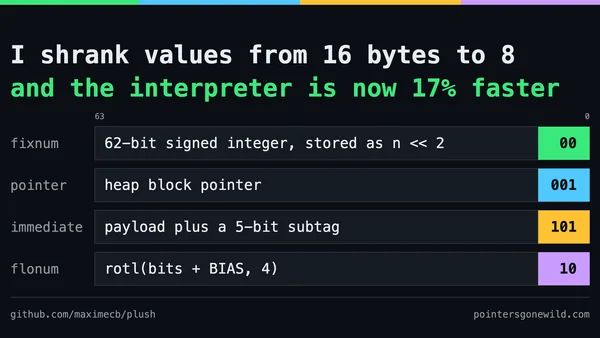
A Plush language interpreter developer replaced a 16-byte Rust enum with a 64-bit word using low-bit tagging, achieving a 17% speedup. The scheme exploits 8-byte heap alignment to store tag bits in the lowest 3 bits of pointers and integers, reducing memory waste in value arrays. Despite added bitwise operations for type dispatch and float unpacking, the performance gain came from better cache utilization and fewer memory accesses.

X sends cease-and-desist to open source project Nitter over alleged scraping
Open Source / techcrunch.com

X sends cease-and-desist to open source project Nitter over alleged scraping

X Corp. sent cease-and-desist letters to Nitter, an open-source project that enabled reading X posts without an account by stripping ads, tracking, and JavaScript. The letters cite violations of the Texas Harmful Access by Computer Act and the Lanham Act, demanding permanent takedown of all instances and the repository. Nitter's creator has taken the flagship instance offline and is seeking legal advice, following X's earlier technical blocks in 2024 that forced instances to connect real X accounts.

General / fzakaria.com

Queryable Executables

A new executable format called SELF treats programs as SQLite databases, enabling the running process to store its own state transactionally within the same file. A proof-of-concept web server, self-httpd, collapses the program, routes, website content, and visitor logs into a single queryable SQLite file, eliminating the need for separate filesystem directories like /var/ or /tmp/. This approach contrasts with redbean's self-extracting ZIP archive by using the database itself as the container, allowing handlers to be defined via INSERT statements into a handlers table.

Article: Beyond Offset Lag: Computing Time in Queue for Apache Hudi Data Lake Pipelines at Petabyte Scale
Security / infoq.com

Article: Beyond Offset Lag: Computing Time in Queue for Apache Hudi Data Lake Pipelines at Petabyte Scale

Twilio built a time-in-queue metric for Apache Hudi pipelines processing 5 trillion records monthly (peak 12.9M msg/s) because Kafka offset lag and Hudi's kafkaDelayCount showed consumers keeping up while downstream analytics reported hours-old data. The solution reads Hudi commit checkpoints from S3, seeks to that offset in Kafka, and computes the timestamp delta to current time—requiring fallback logic when the latest commit lacks checkpoint metadata (e.g., from parallel legacy pipelines). Deployed as a first-class data contract metric, it enables per-pipeline freshness SLAs without modifying producers, consumers, or existing infrastructure.

OpenAI Jalapeño: Better than Nvidia Blackwell
AI/ML / newsletter.semianalysis.com

OpenAI Jalapeño: Better than Nvidia Blackwell

OpenAI's custom inference ASIC 'Jalapeño,' built with Broadcom in just 16 months, beats Nvidia Blackwell and AMD chips on throughput per watt across all tested open-source models, including DeepSeek R1 and Kimi-K2. The chip uses HBM4, achieves over 700 tokens/sec/user at concurrency 1 with single-token prediction, and is a general-purpose inference accelerator—not specialized for OpenAI's models. Performance was verified in-lab using the InferenceX benchmark suite, though AgentX results are pending.