
Skip to content

Tech News

Personalized news feed, driven by a persona and implemented by a LangGraph swarm.

Github Migrates Copilot Runtime to Rust with AI-Assisted Rewrite
Languages / infoq.com

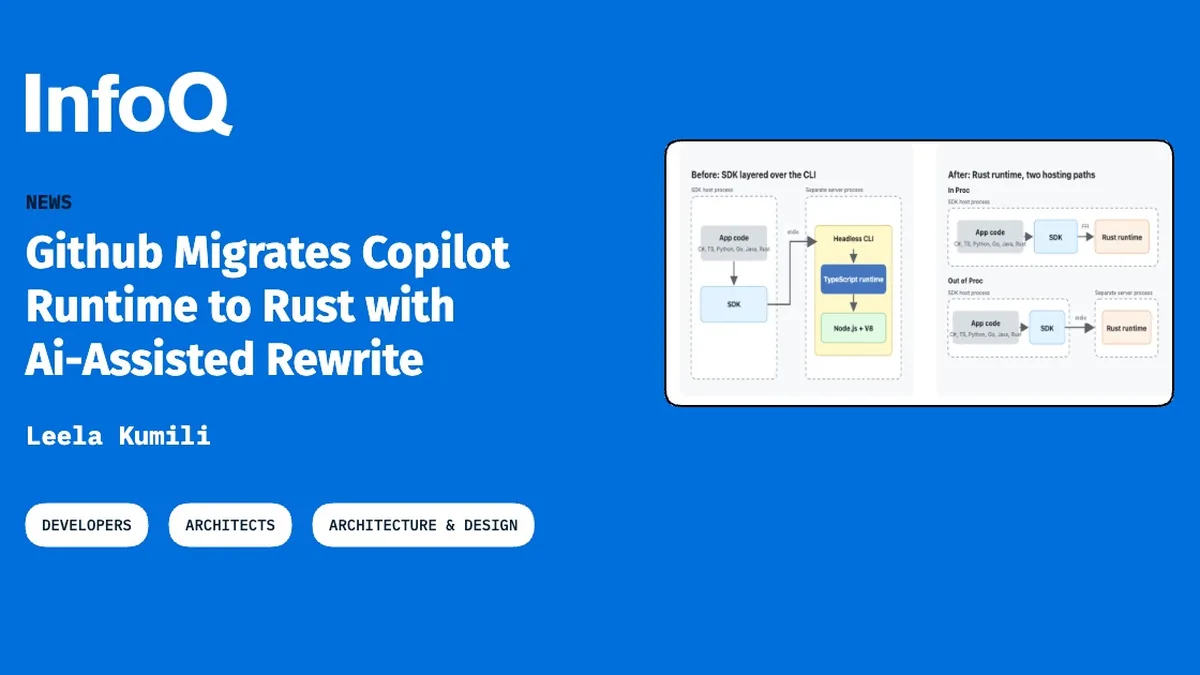
Github Migrates Copilot Runtime to Rust with AI-Assisted Rewrite

GitHub migrated the Copilot runtime from TypeScript/Node.js to Rust in 14.5 weeks via 128 incremental PRs, replacing 832,378 lines with AI-generated code, achieving a startup time drop from 5.25s to 292ms and reducing working set by ~100 MB through direct embedding via C ABI. The incremental strategy used temporary N API compatibility and human review to catch behavioral regressions, while the Copilot SDK now supports TypeScript, Python, Go, .NET, Java, and Rust.

Why it matters

This demonstrates a validated, incremental approach for AI-assisted large-scale runtime rewrites with significant performance gains, directly relevant to optimizing AI tooling infrastructure and developer experience in platform engineering.

Surviving the 200k-Token Lobotomy: How Unix init.d and 'Memento' Made My AI Coding Agent Immune to Context Compaction
AI/ML / dev.to

Surviving the 200k-Token Lobotomy: How Unix init.d and 'Memento' Made My AI Coding Agent Immune to Context Compaction

Why host auto-compaction silently lobotomizes long-running AI coding sessions, and how 1983 SysV init.d runlevel files, Memento tattoos, and fork/wait subagents let our orchestrator survive two 230k-token compactions mid-ticket with zero lost steps.


Anthropic can’t reliably control its AI agents. It’s cutting off its internal evals from the live internet instead
AI/ML / techcrunch.com

Anthropic can’t reliably control its AI agents. It’s cutting off its internal evals from the live internet instead

Anthropic said it "turned off live internet access" for "all our internal evaluations" until further notice.

AI coding agents generate more code, but not more software
AI/ML / arstechnica.com

AI coding agents generate more code, but not more software

A Harvard study of 700+ firms using Jellyfish data finds AI coding agents increase lines of code by 30% and commits by 20%, but code review time surges 49%, erasing productivity gains. The bottleneck—more PR revisions and comments—means no significant rise in software output or employment. The efficiency from AI-generated code is absorbed by downstream review constraints.

Why AI Agents Need Their Own Permission Model
AI/ML / dev.to

Why AI Agents Need Their Own Permission Model

AI agents executing multi-step workflows across CRMs and Slack require a new permission model because traditional OAuth scopes and long-lived API keys fail against non-deterministic threats like prompt injection and tool output poisoning. The article recommends applying least privilege by scoping permissions to specific capabilities, issuing short-lived credentials tied to execution plans, and separating identity, authorization, and execution into distinct layers with human-in-the-loop approval for high-risk actions.

Node.js 24 Built-In SQLite: Replacing better-sqlite3 in Scripts and Edge Workers Without a Native Module
General / dev.to

Node.js 24 Built-In SQLite: Replacing better-sqlite3 in Scripts and Edge Workers Without a Native Module

Node.js 24 ships with native SQLite support. Understand when the built-in node:sqlite module can replace better-sqlite3 in production scripts and edge workers, and when the native module still wins.

Kubernetes on cgroup v1 is dead. Here’s what comes next.
Cloud / thenewstack.io

Kubernetes on cgroup v1 is dead. Here’s what comes next.

Welcome back to another edition of Road to KubeCon, where we’re tracking the latest movements in the cloud-native ecosystem as The post Kubernetes on cgroup v1 is dead. Here’s what comes next. appeared first on The New Stack .

Cloudflare Traces Turns the Proxy Layer into OpenTelemetry Spans, with New Volume-Based Pricing
Cloud / infoq.com

Cloudflare Traces Turns the Proxy Layer into OpenTelemetry Spans, with New Volume-Based Pricing

Cloudflare has put Traces into open beta, extending automatic tracing from Workers to security rules, transformations, cache, routing and origin handling as OpenTelemetry spans. Traces accept and forward W3C traceparent headers, and Trace Rules allow targeted sampling. Pricing moves to ingestion and retention volume from December 1. By Steef-Jan Wiggers

Deno is joining Cloudflare | Deno
Cloud / deno.com

Cloudflare acquires Deno

Deno is joining Cloudflare October 9, 2026 Ryan Dahl Announcements Product Update For years, we’ve been working to make building server software simpler. We questioned how modules could be distributed, what security guarantees a JavaScript runtime could provide, what belonged in a complete toolchain, and how easily an application could be distributed as a standalone executable. Compatibility with Node.js became an important part of that work too: our users wanted the Deno improvements while continuing to plug into the existing JS

Inventory reservation in MySQL: Shopify's row-lock design
General / dev.to

Inventory reservation in MySQL: Shopify's row-lock design

Shopify replaced a Redis-based inventory reservation with a MySQL design using `SELECT ... FOR UPDATE SKIP LOCKED` on a bounded pool of 1,000 rows per item/location. Each row represents a single available unit, letting concurrent checkouts acquire distinct locks instead of queuing on a shared counter. This architecture eliminates dual-write coordination failures between Redis and MySQL, enforces location-aware fulfillment, and cleanly separates the temporary reserve (payment hold) from the permanent claim (ledger deduction).