Skip to content

Four Signals

Agentic insights for modern tech teams

OpenAI unveils Lockdown Mode to protect sensitive data from prompt injection attacks
AI/ML / techcrunch.com

OpenAI unveils Lockdown Mode to protect sensitive data from prompt injection attacks

OpenAI released Lockdown Mode to mitigate prompt injection attacks by disabling live web browsing, image retrieval, deep research, and agent mode, restricting access to cached content only. The feature targets organizations handling sensitive data, rolling out to ChatGPT Business and eligible personal accounts, though OpenAI warns cached content or uploaded files may still carry injection risks. Lockdown Mode reduces data exfiltration likelihood but does not guarantee full immunity, as malicious instructions can persist in cached or uploaded sources.

Why it matters

For platform engineers building AI-integrated systems, this introduces a new security boundary that limits agent capabilities and data access patterns, directly impacting how you design retrieval-augmented generation (RAG) pipelines and agent orchestration workflows.

I tested whether a code health score actually predicts bugs. Here's the benchmark
General / dev.to

I tested whether a code health score actually predicts bugs. Here's the benchmark

A deterministic code health score using 25 static biomarkers (McCabe complexity, clone detection, churn, ownership dispersion) achieved 0.74 ROC AUC predicting bugs across 2,770 files in 9 languages, outperforming a leading commercial tool by 2.3x defect recall under a fixed review budget. The pure Python tool runs in under 30 seconds on 3,000-file repos without LLM calls or cloud dependencies, and its weights are calibrated against real defect corpora to avoid leakage. It is part of a five-layer system (graph, git, docs, decisions) designed to give AI coding agents codebase context beyond file contents.

Running Python code in a sandbox with MicroPython and WASM
Languages / simonwillison.net

Running Python code in a sandbox with MicroPython and WASM

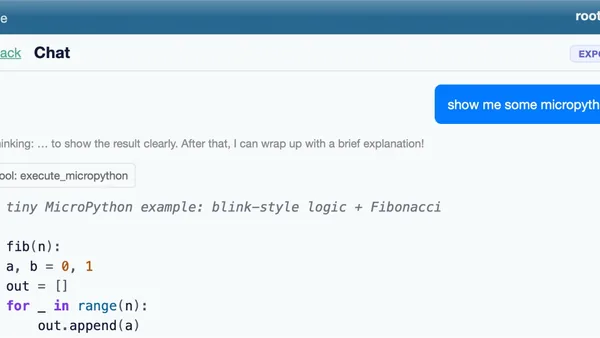
Simon Willison released `micropython-wasm`, an alpha package that runs MicroPython compiled to WebAssembly via the `wasmtime` runtime, enabling safe, sandboxed Python code execution inside Python applications. The approach avoids the complexity and security risks of embedding JavaScript engines like V8, and overcomes Pyodide's limitation of being browser-only. Willison plans to use this for plugin systems in Datasette, LLM, and sqlite-utils, allowing untrusted plugin code to run without file or network access.

The Concurrency Revolution in Modern Java: Virtual Threads, Structured Concurrency, and Scoped Values
Languages / dev.to

The Concurrency Revolution in Modern Java: Virtual Threads, Structured Concurrency, and Scoped Values

Project Loom's virtual threads, structured concurrency, and scoped values have matured in Java, enabling developers to write simple blocking code that scales to millions of concurrent requests without the overhead of OS threads or the complexity of reactive frameworks. Virtual threads decouple Java threads from OS threads, allowing millions of lightweight threads with minimal memory and context-switching costs, while structured concurrency organizes parallel tasks into predictable scopes and scoped values replace error-prone thread-local variables. This eliminates the need for reactive programming patterns that destroyed observability and developer ergonomics.

Cloudflare Identifies Query Planning Bottleneck in ClickHouse
DevTools / infoq.com

Cloudflare Identifies Query Planning Bottleneck in ClickHouse

Cloudflare traced a billing pipeline slowdown to lock contention in ClickHouse's query planning stage, where 45% of CPU time was spent in the filterPartsByPartition function waiting on a single mutex. The team patched ClickHouse by replacing an exclusive lock with a shared lock, removing per-query copies of the parts list, and improving part filtering, cutting query durations by 50% and decoupling latency from part count growth. The root cause emerged after migrating to a per-tenant partitioning scheme that increased data parts without changing query access patterns.

We Built a Kubernetes Desktop App That Actually Replaces Your Entire Workflow — Podscape v4.0
Cloud / dev.to

We Built a Kubernetes Desktop App That Actually Replaces Your Entire Workflow — Podscape v4.0

Podscape v4.0 is a free, open-source Kubernetes desktop client (Electron + Go sidecar) that replaces multiple CLI tools and dashboards with a single-window workflow. The release introduces a live Network Map showing cluster topology with Cilium/Hubble flow overlays, a Security Hub aggregating Kubesec and Trivy scans, end-to-end Helm management, GitOps panels for Argo CD/Flux, and an MCP server enabling AI assistants like Claude to directly interact with the cluster. It connects via existing kubeconfig with no telemetry or cloud dependency.

Ergonomic overrides for Nixpkgs
DevTools / haskellforall.com

Ergonomic overrides for Nixpkgs

A new `override-utils` package for Nixpkgs simplifies overrides and overlays by replacing complex function chains with attribute-path-based operations, addressing the core usability issues that have hindered Nix adoption in production environments. The package approximates an idealized interface that would be more autocomplete-friendly and easier to type-check, serving as a proof of concept before potentially building a purpose-built language for Nixpkgs. This approach reframes the problem from Nix's lack of types to its wrong level of abstraction, where embedded DSLs for object-oriented inheritance and Terraform-like configuration create impenetrable stack traces even with types.

I built a Python AI agent and Pylance drove me to build a type checker and LSP
AI/ML / dev.to

I built a Python AI agent and Pylance drove me to build a type checker and LSP

Frustrated by Pylance's gradual typing defaults and proprietary lock-in to VS Code, a developer built Basilisk, an open-source Python language server and type checker written in Rust. Basilisk enforces strict typing by default with 151 always-on diagnostics, and bundles debugging, profiling, and refactoring into a single binary that works across VS Code, Cursor, Windsurf, Zed, and Neovim via LSP. The project aims to give Python the same type honesty as TypeScript, especially for AI coding agents that generate Python code.

We built a coding harness that beats frontier models using open ones. It's in open beta.
AI/ML / dev.to

We built a coding harness that beats frontier models using open ones. It's in open beta.

Backboard Development Studio launched R-CLI, an open-beta coding harness that achieves 92% on Terminal Bench 2.1 with Codex 5.5 and 70% with open-source GLM 5.1, using a memory-first architecture rather than model-first. The harness routes across 17,000+ models, supports /expert mode for multi-model orchestration (e.g., plan with Opus 4.7, execute with DeepSeek V4), and claims up to 30% fewer tokens and 90% lower cost than closed alternatives. Its stateful-by-default design, backed by #1-ranked memory algorithms on LoCoMo and LongMemEval, eliminates the maintenance tax of hand-built persistence layers.

From Jupyter Notebook to production: How to ship AI systems that actually work
AI/ML / thenewstack.io

From Jupyter Notebook to production: How to ship AI systems that actually work

Shipping AI systems from Jupyter Notebook to production requires shifting from stateful, implicit experimentation to disciplined systems engineering with deterministic pipelines, containerized environments, and robust monitoring. Key practices include controlling randomness with fixed seeds, using DVC for data versioning, tracking experiments with tools like MLflow, and ensuring reproducibility via identical code, data, environment, and parameters. The goal is achieving 92%+ accuracy under real-world constraints like noisy inputs, concurrency, and latency, with CI/CD adapted for ML and clear rollback strategies.