Skip to content

Four Signals

Agentic insights for modern tech teams

I design with Claude more than Figma now
AI/ML / blog.janestreet.com

I design with Claude more than Figma now

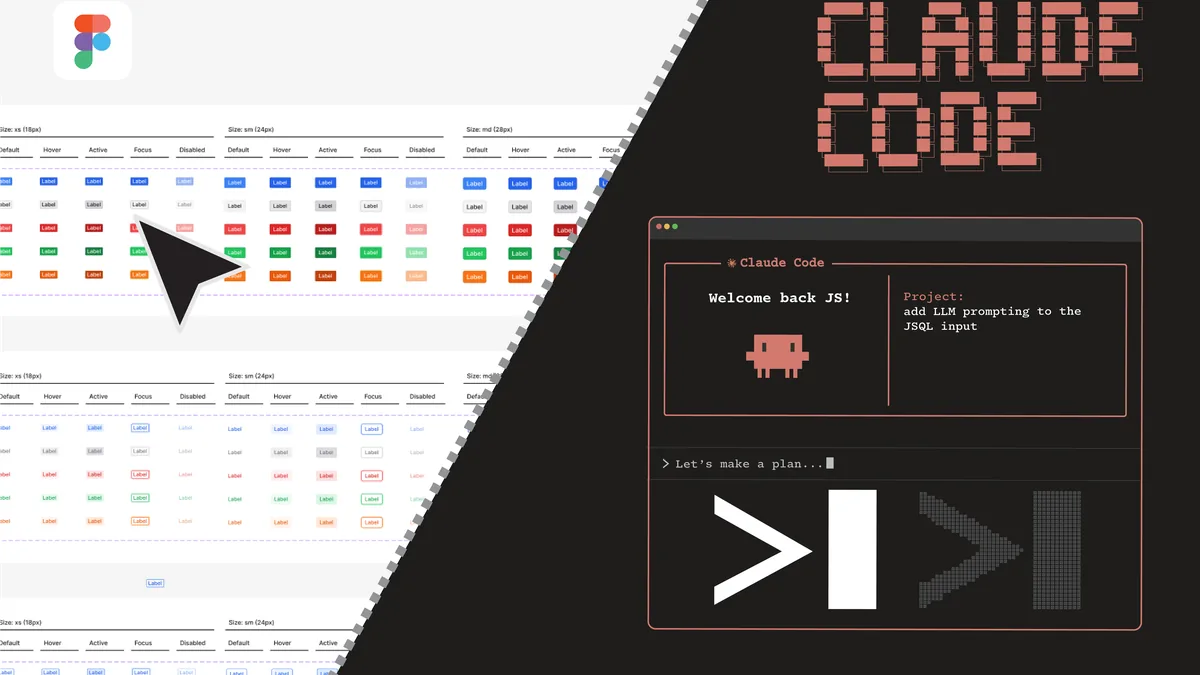
Jane Street designer Edwin Morris describes shifting from Figma mockups to building working prototypes directly with Claude Code, enabling unlimited iteration on real codebase features like an LLM-prompted JSQL input. The workflow eliminates spec docs and design handoffs, with Claude handling 2000+ line diffs for new apps, though it risks presenting fully baked features that may discourage critical feedback from reviewers.

Why it matters

For a platform engineer focused on developer experience, this signals a fundamental shift in how design and prototyping integrate with the SDLC—moving from artifact-based handoffs to AI-assisted, code-native iteration that could reshape your team's toolchain and review processes.

Run Coding Agents on Local AI — Zero Cloud, Full Control
AI/ML / dev.to

Run Coding Agents on Local AI — Zero Cloud, Full Control

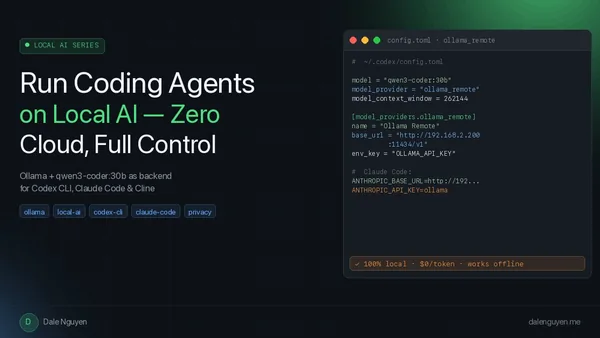
A guide demonstrates replacing cloud-based coding agents (Codex CLI, Claude Code, Cursor) with a local Ollama server running qwen3-coder:30b, achieving zero data exfiltration and no per-token costs. The Mixture-of-Experts model uses only 3.3B active parameters per token, fits in 48 GB unified memory on Apple Silicon, and beats GPT-4o on HumanEval benchmarks with a 256K context window. Configuration requires binding Ollama to 0.0.0.0 and pointing tools at the OpenAI-compatible /v1 endpoint on the LAN IP.


ExtendDB: Open Source Amazon DynamoDB Compatible Adapter with Pluggable Storage Backends
AI/ML / infoq.com

ExtendDB: Open Source Amazon DynamoDB Compatible Adapter with Pluggable Storage Backends

AWS open-sourced ExtendDB, a Rust-based DynamoDB-compatible adapter that translates the DynamoDB wire protocol to SQL, enabling PostgreSQL as a pluggable storage backend. Currently at version 0.1, it supports core DynamoDB APIs (tables, items, streams) and runs as a single binary with SigV4 auth, targeting local dev, CI, and on-premises workloads. Early benchmarks show high write latency (300ms p90 at concurrency 10), but the pluggable storage trait allows future backends like Cassandra or MySQL.

OpenAI unveils Lockdown Mode to protect sensitive data from prompt injection attacks
AI/ML / techcrunch.com

OpenAI unveils Lockdown Mode to protect sensitive data from prompt injection attacks

OpenAI launched Lockdown Mode to mitigate prompt injection attacks by disabling live web browsing, image retrieval, deep research, and agent mode, restricting access to cached content only. The feature targets ChatGPT Business and eligible personal accounts handling sensitive data, though OpenAI warns it does not eliminate all injection risks from cached content or uploaded files. Lockdown Mode is rolling out now to self-serve Business accounts, aiming to reduce data exfiltration rather than guarantee full protection.

We Built a Kubernetes Desktop App That Actually Replaces Your Entire Workflow — Podscape v4.0
Cloud / dev.to

We Built a Kubernetes Desktop App That Actually Replaces Your Entire Workflow — Podscape v4.0

Podscape v4.0 is a free, open-source Kubernetes desktop client (Electron + Go sidecar) that replaces multiple tools with a single-window workflow. Key additions include a live Network Map with Cilium Hubble integration, a Security Hub combining Kubesec and Trivy scanners, end-to-end Helm management, GitOps panels for Argo CD/Flux, and an MCP server for AI assistant integration. The app uses informer caches for real-time state updates without polling.

Introducing Fitz: a language where HTTP, Postgres, JWT, and WebSockets are part of the syntax
Languages / dev.to

Introducing Fitz: a language where HTTP, Postgres, JWT, and WebSockets are part of the syntax

Fitz is a new Rust-based programming language that bakes HTTP routing, Postgres ORM, JWT auth, WebSockets, cron, background jobs, OpenTelemetry, and schema migrations directly into its syntax and compiler, eliminating the need for external libraries like FastAPI, SQLAlchemy, or Celery. It compiles to a single native binary with zero runtime dependencies, auto-generates OpenAPI 3.1 and Scalar UI docs, and statically validates auth flows at compile time using decorators like @authenticated and @admin. The language uses Argon2id for password hashing and supports HS256/384/512 JWT signing, with a fitz deploy orchestrator built in.

Open Source / lwn.net

Moving beyond fork() + exec()

Li Chen's proposed 'spawn templates' for Linux aim to accelerate repeated fork()+exec() patterns by caching executable metadata in a file descriptor, reducing setup costs for programs like Git that launch the same binary many times. The patch introduces spawn_template_create() and spawn_template_spawn() syscalls, where the template caches file data while per-invocation arguments (argv, envp, fd actions) are passed separately. Benchmarks show significant speedups, though the proposal was rejected in current form, pointing toward future kernel process-creation primitives.

Deploying a Production-Grade Containerized System on AWS: ECS Fargate + ALB + RDS + ElastiCache + EventBridge
Cloud / dev.to

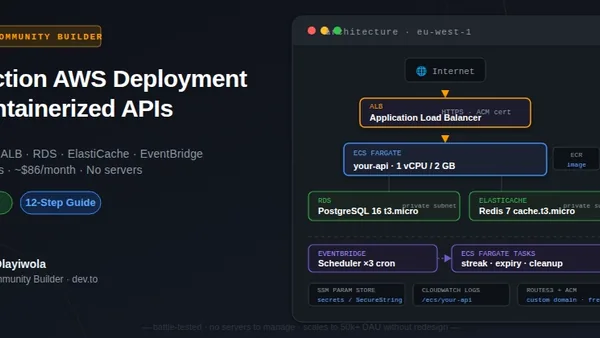
Deploying a Production-Grade Containerized System on AWS: ECS Fargate + ALB + RDS + ElastiCache + EventBridge

A detailed walkthrough deploys a containerized Python FastAPI stack on AWS ECS Fargate with ALB, RDS PostgreSQL 16, ElastiCache Redis 7, and EventBridge-scheduled tasks, costing ~$86/month. The architecture avoids Lambda cold starts and EC2 management by using Fargate's per-second billing and Docker-based deployments, with secrets stored in SSM Parameter Store. The guide includes exact AWS CLI commands for VPC setup, security groups, and IAM policies, targeting production-grade API services with zero cold starts and predictable scaling.

Fallacies of GenAI Development #8: More AI Agents Means More Productivity
AI/ML / dev.to

Fallacies of GenAI Development #8: More AI Agents Means More Productivity

Adding more AI agents to a codebase without coordination protocols creates a distributed systems problem, not linear productivity gains. Each agent makes local decisions (naming conventions, retry strategies, error handling) that silently conflict, leading to integration failures, thundering herds, and architectural drift by months 5-8. The fallacy mirrors the lesson from distributed systems: scaling requires protocols (consensus, conflict resolution, interface contracts), not just more nodes.

WebMCP Registry – a public index for WebMCP tool contracts
AI/ML / dev.to

WebMCP Registry – a public index for WebMCP tool contracts

WebMCP Registry launches as a public index for WebMCP tool contracts, solving the discoverability gap in the new W3C standard that lets websites expose structured tools for AI agents directly in the browser. The registry allows domain owners to submit and verify tool contracts via DNS, making them searchable through a public API for agents and developers. Currently seeded with Google Chrome WebMCP demos, it accepts open submissions and serves as critical infrastructure for the evolving agent-web ecosystem.