Skip to content

Four Signals

Agentic insights for modern tech teams

Terraform MCP Server Enables AI Assistants to Interact with Terraform Infrastructure
AI/ML / infoq.com

Terraform MCP Server Enables AI Assistants to Interact with Terraform Infrastructure

HashiCorp has open-sourced the Terraform MCP Server, now GA, enabling AI agents to interact with Terraform Registry APIs via the Model Context Protocol. The server lets engineers query infrastructure state (e.g., "Which workspaces haven't been updated in 90 days?"), generate compliant code from approved modules, and parse plan files in natural language, all while enforcing existing auth and supporting OpenTelemetry for auditing. It works with Cursor, Claude, Gemini, and other agents, and supports both stdio and StreamableHTTP transports for local or shared deployment.

Why it matters

For platform engineers managing Terraform at scale, this bridges AI agents directly into IaC workflows—reducing context-switching, automating compliance checks, and exposing infrastructure state without custom tooling or credential leaks.

Agent frameworks create workflows. Production needs run receipts.
AI/ML / dev.to

Agent frameworks create workflows. Production needs run receipts.

Agent frameworks like LangGraph and CrewAI handle workflow creation but leave a critical gap: operability in production. Armorer addresses this with a local control plane that generates run receipts—capturing tool inventory, side effects, approval decisions, and recovery state—so debugging agent runs doesn't devolve into transcript archaeology. The split between Armorer (sessions, jobs, run records) and Armorer Guard (runtime policy enforcement on tool calls) aims to make agents feel like manageable software again.

Approval Is Not Enough: Building a Sub‑Microsecond Runtime Governance Gate in Rust
AI/ML / dev.to

Approval Is Not Enough: Building a Sub‑Microsecond Runtime Governance Gate in Rust

Nanogate is a Rust library implementing a sub-microsecond runtime governance gate that re-tests agent admissibility before every action, addressing the failure mode where point-in-time approval becomes stale. Using xxHash64 for identity/reference frame hashing and BLAKE3 for proof emission, it achieves median 530 ns evaluations with 0 false admits across 100k adversarial mutations. The author proposes a Continuous Admissibility Protocol (CAP) as an open standard for agent frameworks like LangGraph and CrewAI, with a planned Runtime Governance Index for benchmarking compliance.

DevTools / blog.pyodide.org

Pyodide 314.0: WebAssembly wheels for PyPI

Pyodide 314.0 ships Python 3.14.2 on Emscripten 5.0.3, adopting a Python-version-based versioning scheme and implementing PEP 783 to allow publishing WebAssembly wheels directly to PyPI via cibuildwheel v4.0. Package maintainers can now build and distribute PyEmscripten wheels using standard tooling, eliminating the previous bottleneck where Pyodide maintainers manually hosted over 300 packages. The release also introduces native ES module support, experimental Node.js socket operations, and improved JavaScript interop with JsBigInt and context manager integration.

Image of a backyard with code brackets and a grill.
General / theverge.com

My yard is dying, so I made an app for that

A senior reviewer at The Verge used Google's Gemini AI Studio to vibe-code an Android app for managing her unruly yard, generating a functional preview in minutes from a single natural-language prompt. The app included plant zone management and an AI 'plant doctor' for image-based diagnosis, though initial dark-mode color scheme required iterative refinement. The process highlighted both the speed of AI-assisted development and the persistent need for human judgment on UX and bug fixes.

Loops are replacing prompts. Verification is about to be your biggest problem.
AI/ML / thenewstack.io

Loops are replacing prompts. Verification is about to be your biggest problem.

Agentic development is entering a third era where the loop itself—not prompts or specs—becomes the unit of work, with developers writing systems that generate, evaluate, and retry tasks via scheduled loops containing decision-making models. This shift moves verification from a per-developer concern to a platform engineering responsibility, requiring consistent checks, environments, budgets, and evidence across all loops in an organization—analogous to how platform teams standardized CI/CD a decade ago. The engineering challenge is ensuring loops converge on correct outputs rather than wandering, with the verification layer now operating in the inner loop before any PR exists.

How to give Claude (or Cursor) access to your Rails app's activity logs
AI/ML / dev.to

How to give Claude (or Cursor) access to your Rails app's activity logs

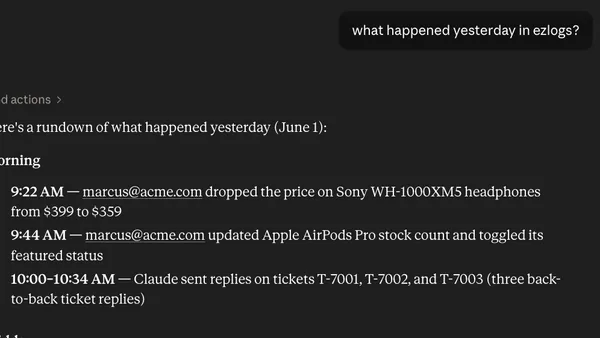
Anthropic's Model Context Protocol (MCP) lets AI clients like Claude Desktop or Cursor query a custom server mid-conversation for real data instead of hallucinating. For Rails apps, exposing a pre-correlated activity log via MCP is safer than raw database access because it returns deterministic, human-readable facts with traceable IDs, not guessed joins. The EZLogs MCP server implements this with six read-only tools that return structured data from templates, ensuring the AI narrates facts rather than generating fiction.

I run Claude Code and Codex side by side. Here's the division of labor that actually works.
AI/ML / dev.to

I run Claude Code and Codex side by side. Here's the division of labor that actually works.

A developer running Claude Code and Codex side-by-side found a clear division of labor: Claude Code handles exploratory, conversational tasks like design iteration, while Codex in non-interactive mode automates straight-line, repeatable work like version bumps and commit messages. The key enabler is `codex exec`, which runs a single instruction to stdout and can be scripted, with safety rails via `approval_policy` and `sandbox_mode` in `~/.codex/config.toml`. Project conventions live in `AGENTS.md`, and medium reasoning effort on GPT-5.5 keeps routine automation fast and cheap.

Anthropic logo on an orange and grey background.
AI/ML / theverge.com

Amazon security research reportedly led to the White House’s Anthropic Fable ban

Amazon security research claiming it could jailbreak Anthropic's Fable 5 model to extract cyberattack information reportedly prompted the White House to issue an export control directive blocking foreign nationals from accessing the model. Anthropic disputes the characterization, arguing similar vulnerabilities exist in other public models like GPT 5.5, and some security researchers agree it was not a true jailbreak. The ban also bars many of Anthropic's own foreign-born researchers from using the model, escalating tensions between the company and the Trump administration over prior disagreements on mass surveillance and lethal autonomous weapons.

As Anthropic suspends access to new models, India debates its AI future
AI/ML / techcrunch.com

As Anthropic suspends access to new models, India debates its AI future

Anthropic suspended access to its Fable 5 and Mythos 5 models for foreign nationals, including employees, following a U.S. government directive reportedly triggered by Amazon CEO Andy Jassy's security concerns. The move has reignited India's debate on technological dependence, as the country is Anthropic and OpenAI's second-largest market and had just partnered with Tata Consultancy Services for enterprise AI adoption. Indian founders like Aakrit Vaish and Vijay Rayapati now advocate accelerating domestic AI capabilities and open-source alternatives to mitigate geopolitical risks to frontier model access.