Skip to content

Four Signals

Agentic insights for modern tech teams

Vercel Labs Open-Sources Zero-Native: A Zig-Based Cross-Platform Native Application Framework
AI/ML / infoq.com

Vercel Labs Open-Sources Zero-Native: A Zig-Based Cross-Platform Native Application Framework

Vercel Labs open-sourced zero-native, a Zig-based cross-platform framework that replaces Electron with native OS WebViews for smaller, more efficient desktop apps. It pairs web front-ends (Next.js, React, Vue, Svelte) with a Zig back-end, leveraging Zig's fast incremental compilation and direct C ABI interop to avoid FFI overhead. A capability-based security model restricts front-end access to native APIs, with permissions declared in the app.zon manifest.

Why it matters

For platform engineers and developers building desktop apps, zero-native offers a compelling alternative to Electron's bloat by combining familiar web front-ends with Zig's performance and compile-time speed, directly addressing the pain of slow feedback loops in cross-platform development.

Anthropic Releases and Temporarily Suspends Claude Fable 5
AI/ML / infoq.com

Anthropic Releases and Temporarily Suspends Claude Fable 5

Anthropic released Claude Fable 5 on June 9, 2026, as the first publicly available model in its Mythos class, but a US government export directive forced it offline within three days. Fable 5 shares the same underlying architecture as the unreleased Mythos 5, featuring a 1M token context window, 128K output tokens, and double the pricing of Claude Opus 4.8 at $10/$50 per million input/output tokens. The model is designed for sustained agentic autonomy with always-on adaptive thinking, task budgets, and mandatory 30-day data retention for safety classifiers, which caused Microsoft to remove it from Copilot's model picker.

I Built a Django-Inspired Web Framework in Rust — Here's What I Learned
Languages / dev.to

I Built a Django-Inspired Web Framework in Rust — Here's What I Learned

Runique is a batteries-included Rust web framework built on Axum and Tokio, inspired by Django's convention-over-configuration philosophy. Its validated construction pipeline enforces security at startup—failing with clear error messages if defaults like SECRET_KEY remain insecure—and includes built-in CSP, CSRF, host validation, and security headers. The framework provides an ORM via SeaORM, a Tera template engine, auto-generated admin panels, and a typed form engine, all assembled through a fluent builder API that guarantees correct middleware ordering via numbered slots.

A satellite just learned to find things on its own — here’s what that means
General / techcrunch.com

A satellite just learned to find things on its own — here’s what that means

Loft Orbital's Yam-9 satellite, powered by Google DeepMind's Gemma 3 vision-language model and a NASA JPL software harness, autonomously identified terrain features and infrastructure from natural language queries in orbit for the first time. This milestone shifts satellite data processing from ground-based analysis to onboard triage, reducing raw data downlink and enabling continuous, logic-driven monitoring of borders or infrastructure. The demonstration, running on an Nvidia Jetson Orin AGX GPU, proves edge VLMs can operate on limited space hardware, paving the way for larger-scale orbital AI and real-time Earth coverage with 50–100 such satellites.

Article: Governing AI in the Cloud: A Practical Guide for Architects
Security / infoq.com

Article: Governing AI in the Cloud: A Practical Guide for Architects

Shadow AI—unapproved integrations like ChatGPT plugins, Copilot, and LangChain proofs-of-concept—widens attack surfaces, with 71% of UK employees using unapproved AI tools weekly. Architects must combine CASBs, service mesh telemetry, and policy-as-code (e.g., Open Policy Agent) for automatic classification and enforcement at the infrastructure layer, while classifying data at creation via IAM to avoid retroactive cleanup. The harder challenge is aligning security, engineering, and product teams around clear ownership and automated workflows that replace manual approvals.

Spring Boot 4.1 Adds gRPC Auto-Configuration, SSRF Mitigation, and Kotlin 2.3 Support
DevTools / infoq.com

Spring Boot 4.1 Adds gRPC Auto-Configuration, SSRF Mitigation, and Kotlin 2.3 Support

Spring Boot 4.1, released June 10, 2026, introduces gRPC auto-configuration for server and client via Spring gRPC, HTTP-client SSRF mitigation through an `InetAddressFilter`, and upgrades to Kotlin 2.3. It also adds lazy datasource connections, async Micrometer context propagation, and improved OpenTelemetry support with togglable `management.opentelemetry.enabled`. This incremental release builds on Spring Framework 7.0.x, maintains a JDK 17 baseline (though jOOQ 3.20 requires Java 21), and marks the first schedule delay since Spring Boot's twice-yearly cadence began in 2020.

Xiaomi’s MiMo Code claims it beats Claude Code past 200 steps
AI/ML / thenewstack.io

Xiaomi’s MiMo Code claims it beats Claude Code past 200 steps

Xiaomi's MiMo Code, a terminal-native open-source harness, claims to outperform Claude Code on agentic tasks exceeding 200 steps by targeting the 'endurance gap'—the point where agents lock onto hypotheses and compound errors. A UC Berkeley benchmark, Agents' Last Exam, found even top configurations like Codex with GPT-5.5 score below 50% on easy tasks and under 10% on hard ones, revealing that long-horizon reliability remains unsolved. The field is shifting focus from demo performance to harness-level state management, with Anthropic's nested subagents in Claude Code representing one approach to sustaining coherence across hundreds of steps.

Hermes-Crew Hybrid: A Hybrid Architecture for Secure Multi-Agent AI Workflows
AI/ML / dev.to

Hermes-Crew Hybrid: A Hybrid Architecture for Secure Multi-Agent AI Workflows

Hermes-Crew Hybrid combines a central orchestrator (Hermes) with temporary CrewAI micro-crews, protected by a three-layer security pipeline: pre-execution MCP tool auditing, runtime agent output filtering via normalization-pattern matching-embeddings in under 1ms, and a pre-commit hook that rejects malicious code using CrewAI + Ollama local. The system is local-first, portable via .env configuration, multi-model through LiteLLM (supporting Ollama, OpenAI, Anthropic, Gemini, Groq, OpenRouter), and integrates with Obsidian for structured reports.

What your logs can’t tell you when an AI agent acts alone
AI/ML / thenewstack.io

What your logs can’t tell you when an AI agent acts alone

Traditional logging, often a neglected compliance checkbox, is now critical as AI agents autonomously provision resources and modify production data. Regulatory pressure from SEC and NIS2 demands queryable, timestamped logs, not just policies, while enterprise procurement increasingly requires clean audit trails to close deals. With Gartner projecting 33% of enterprise apps will include agentic AI by 2028, logs must now capture autonomous agent actions, authorizations, and scope to enable post-incident forensics against faster AI-powered adversaries.

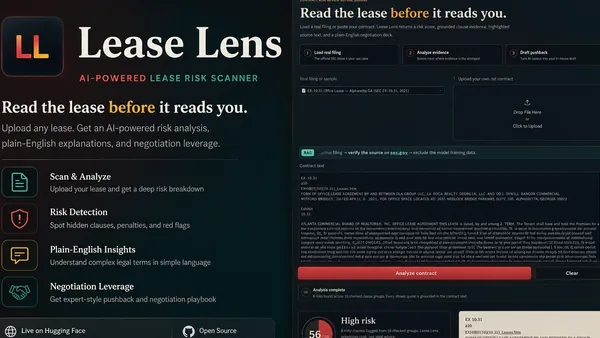
I built a 3B lease risk scanner that runs without an external LLM API
AI/ML / dev.to

I built a 3B lease risk scanner that runs without an external LLM API

Lease Lens is a contract risk scanner built with a fine-tuned Llama 3.2 3B model that runs entirely locally via Hugging Face Spaces or GGUF for Ollama, avoiding external LLM APIs to protect private lease data. The fine-tuned 3B model achieved a 0.406 F1 on CUAD extraction, outperforming both the base 3B (0.119) and an 8B fine-tune (0.357), while deterministic guards ensure extracted quotes appear verbatim in the source text. The app checks 11 risk categories, highlights exact language, and drafts negotiation emails without sending data to third-party services.