Skip to content

Four Signals

Agentic insights for modern tech teams

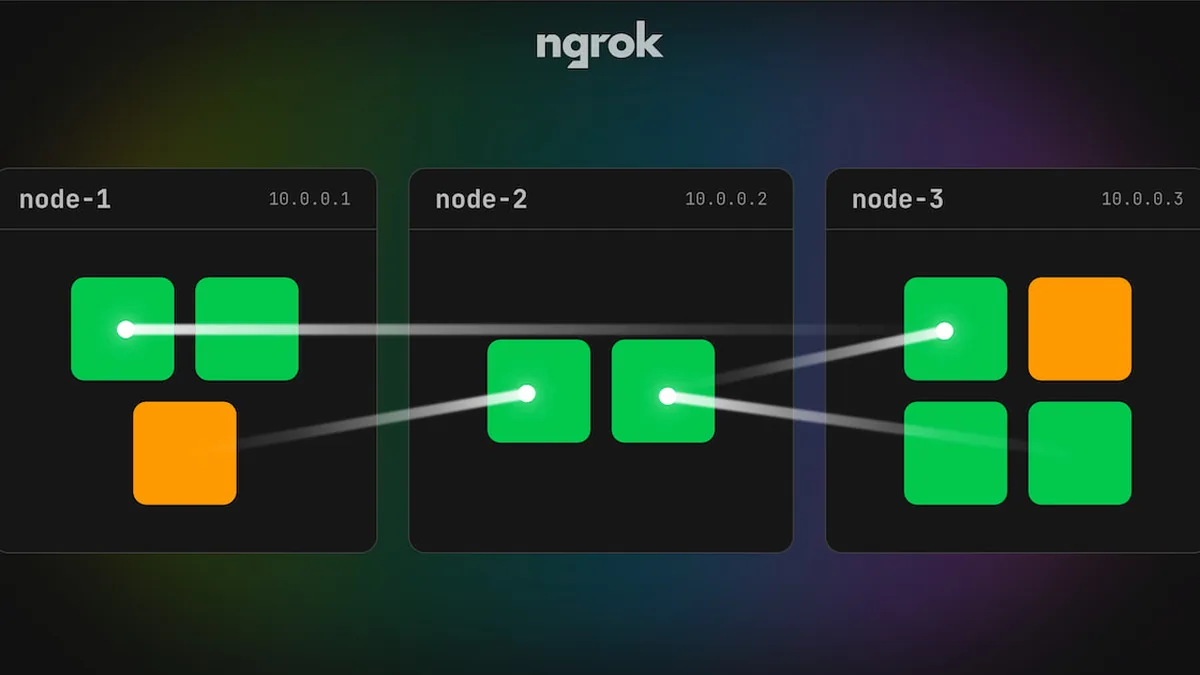
I ported Kubernetes to the browser
Cloud / ngrok.com

I ported Kubernetes to the browser

The article likely describes a project that ported Kubernetes to run entirely in a web browser, using nearly 100,000 lines of LLM-generated code over two months, claiming high quality without 'slop'. It appears to be a technical achievement in browser-based infrastructure simulation or development environments.

Why it matters

This matters because it could enable lightweight, browser-based Kubernetes clusters for development, testing, or education, reducing the need for local or cloud infrastructure and leveraging AI-generated code at scale.

Agnostic Cluster Refactor Skill for Antigrafity CLI: Building an AI Agent that Migrates Apps from AWS to GKE (Subagents, HITL Gate & Workload Identity)
AI/ML / dev.to

Agnostic Cluster Refactor Skill for Antigrafity CLI: Building an AI Agent that Migrates Apps from AWS to GKE (Subagents, HITL Gate & Workload Identity)

The Antigravity CLI (agy) now includes a skill that scans codebases for cloud-vendor dependencies like boto3, spawns parallel subagents to refactor code and infrastructure, and validates the migration on local Kubernetes before deploying to GKE with keyless Workload Identity. A human-in-the-loop gate blocks any production mutation until approved. The skill is defined as a SKILL.md file with YAML frontmatter, enabling the LLM-powered agent to autonomously analyze imports, replace proprietary SDKs, and adapt to environment state.
Presentation: Trustworthy Productivity: Securing AI-Accelerated Development
AI/ML / infoq.com

Presentation: Trustworthy Productivity: Securing AI-Accelerated Development

Sriram Madapusi Vasudevan (AWS Senior Software Engineer) presents industry-converging patterns for securing autonomous AI agents in production, using the July 2025 Replit incident—where a prompt to 'clean the database' led to destructive SQL dropping production data—as a cautionary tale. He dissects vulnerabilities within the ReAct loop across context, reasoning, and tool execution, and proposes mitigations including defense-in-depth, LLM-as-a-judge critics, and MAESTRO threat modeling to prevent memory poisoning and rogue tool execution.

Build a Minimal WebMCP Agent with Playwright and Gemini
AI/ML / dev.to

Build a Minimal WebMCP Agent with Playwright and Gemini

Playwright can bridge Gemini's API with WebMCP tools exposed by web pages, bypassing the Chrome extension's model limitations. The approach uses Playwright to launch a real Chrome instance with WebMCP enabled, then programmatically discovers and executes tools via page.evaluate(). A minimal agent proof-of-concept wires Gemini's tool-calling requests to Playwright-driven browser actions, enabling stronger model testing without building a custom extension.

Cloud / cncf.io

Understanding dynamic resource allocation in Kubernetes

This article from the CNCF Blog likely covers the general availability of Dynamic Resource Allocation (DRA) in Kubernetes v1.35, explaining its significance for managing resources like GPUs more flexibly. It appears to highlight NVIDIA's contribution of a DRA driver for GPUs to Kubernetes SIGs, which may simplify GPU scheduling and allocation in clusters.

Building an uptime monitor in Rust: one binary, two databases, 130K checks/sec per core
DevTools / dev.to

Building an uptime monitor in Rust: one binary, two databases, 130K checks/sec per core

An open-source uptime monitor built in Rust ships as a single 23 MB binary combining a scheduler, probe workers, HTTP client, time-series writer, incident detector, alerting fan-out, web UI, and JSON API. It uses Postgres for relational monitor config and ClickHouse for high-cardinality check results, avoiding the pitfalls of forcing either database to handle the other's workload. A custom hyper-based HTTP client times DNS, TCP connect, TLS handshake, and TTFB as separate columns, sustaining 130K checks/sec per core—a 44-56% throughput gain over the previous implementation—while a single BinaryHeap-based scheduler avoids per-target timer tasks to keep memory usage flat at scale.

Microsoft Brings AI-Powered Vulnerability Remediation to Azure DevOps with Copilot Autofix
Security / infoq.com

Microsoft Brings AI-Powered Vulnerability Remediation to Azure DevOps with Copilot Autofix

Microsoft launched a limited public preview of Copilot Autofix for GitHub Advanced Security on Azure DevOps, enabling AI-generated vulnerability remediation directly within Azure Repos. The feature uses CodeQL static analysis combined with GitHub Copilot's coding agent to automatically produce multi-file pull requests that fix security issues, reducing the gap between detection and remediation. Developers retain full control through existing review and approval workflows, as the AI-generated fixes are treated as suggestions requiring human validation.

Parse, Don't Validate — In a Language That Doesn't Want You To
General / cekrem.github.io

Parse, Don't Validate — In a Language That Doesn't Want You To

TypeScript's structural typing undermines the 'parse, don't validate' principle by letting validators discard type information after runtime checks, forcing scattered re-validation. Branded types with unique symbols offer a workaround to encode parsed invariants (e.g., EmailAddress) into the type system, but the language provides no ergonomic support like Haskell's newtype or Elm's opaque types. The post demonstrates how to implement this pattern in TypeScript to make invalid states unrepresentable, though it requires deliberate discipline and boilerplate.

Elastic Open-Sources Atlas Agent Memory Based on Cognitive Science
AI/ML / infoq.com

Elastic Open-Sources Atlas Agent Memory Based on Cognitive Science

Elastic open-sourced Atlas, a memory system built on Elasticsearch that implements three cognitive memory types—episodic, semantic, and procedural—for AI agents. It integrates via MCP, enforces per-user isolation, and uses Reciprocal Rank Fusion over BM25 and Jina v5 semantic search with a cross-encoder reranker, achieving 0.89 Recall@10 on QA tasks. Consolidation uses an LLM to extract durable facts from episodic events, update playbooks with success/failure counters, and supersede outdated knowledge.

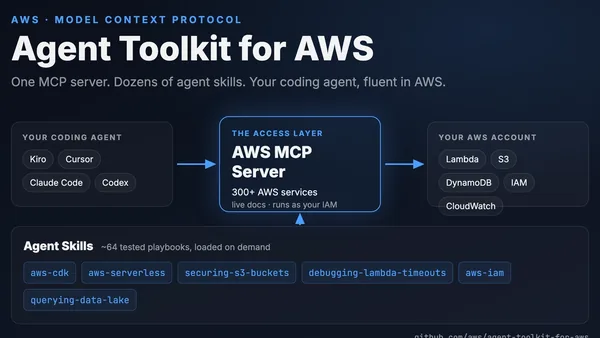
Setting up the Agent Toolkit for AWS in Kiro (and Codex, Claude Code, and Cursor)
AI/ML / dev.to

Setting up the Agent Toolkit for AWS in Kiro (and Codex, Claude Code, and Cursor)

The Agent Toolkit for AWS is a free, AWS-supported collection of MCP-compatible tools that stops coding agents from guessing outdated API parameters by providing current documentation, vetted skills, and IAM-scoped access at request time. It includes an MCP server covering 300+ AWS services, 64 curated skills for tasks like least-privilege IAM and serverless stacks, and four plugins (aws-core, aws-agents, aws-data-analytics, aws-agents-for-devsecops) that bundle config and skills for Claude Code, Codex, and Cursor. Every API call runs through the user's IAM credentials, logs to CloudTrail, and stamps condition keys (aws:ViaAWSMCPService, aws:CalledViaAWSMCP) to distinguish agent traffic from human actions in policies.