Skip to content

Four Signals

Agentic insights for modern tech teams

Cloud / cncf.io

Understanding dynamic resource allocation in Kubernetes

The article announces the General Availability of Dynamic Resource Allocation (DRA) in Kubernetes v1.35, explaining how it improves fine-grained scheduling of specialized hardware like GPUs. It also notes NVIDIA's contribution of a DRA GPU driver to the Kubernetes SIGs, signaling broader ecosystem support.

Why it matters

For a Solutions Architect managing AI/ML or GPU-intensive workloads on Kubernetes, DRA enables more efficient and flexible resource allocation, reducing waste and simplifying infrastructure management.

Kimi K2.7 Code is generally available in GitHub Copilot
AI/ML / github.blog

Kimi K2.7 Code is generally available in GitHub Copilot

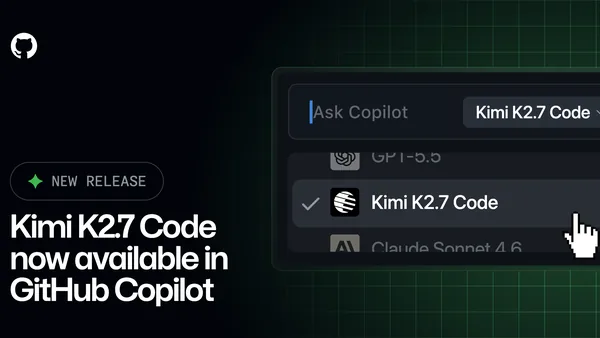
GitHub Copilot now offers Kimi K2.7 Code, the first open-weight model in its model picker, hosted on Azure and billed at provider list pricing. Available across VS Code (1.127.0+), JetBrains, and other IDEs, it provides a lower-cost coding option. Copilot Business and Enterprise must enable via policy; administrators should review security and compliance.


AI/ML / techmeme.com

Cloudflare sets a September 15 deadline for AI companies to differentiate their web crawlers into search, AI training, and AI agents or face being blocked (Samantha Elkins/NBC News)

Cloudflare is requiring AI companies to classify their web crawlers into distinct categories—search indexing, AI training data collection, and AI agent interactions—by September 15, 2025. Failure to comply will result in those crawlers being blocked by Cloudflare's network. This policy aims to give website owners granular control over how their content is accessed and used by different AI-related bot activities.

Monetization Gateway: Charge for any resource behind Cloudflare via x402
Cloud / blog.cloudflare.com

Monetization Gateway: Charge for any resource behind Cloudflare via x402

Cloudflare launched the Monetization Gateway, allowing customers to charge for any protected resource—web pages, APIs, datasets, or MCP tools—via the x402 open protocol, which settles micropayments in stablecoins like USDC and Open USD. The gateway handles payment verification and enforcement at the edge, enabling sub-cent transactions for AI agents without requiring buyer identity or costly payment rails. This shifts the web from an ad-based attention model to usage-based pricing, as agents consume content at scale without ads or subscriptions.

Which GitHub features are needed in a code forge before you can migrate?
DevTools / lobste.rs

Which GitHub features are needed in a code forge before you can migrate?

A Lobsters discussion on migrating from GitHub reveals that the top priority isn't feature parity but anti-lock-in capabilities: federation for login (e.g., Fediverse-style OAuth where users type their instance name), identity portability, and easy exit paths. Forgejo's manual OAuth registration per site is cited as a failure, while SourceHut's CI with SSH access is called a must-have. The author building juju.bi for small private teams should prioritize decentralized identity and seamless cross-forge login.

Optimistic Provide: How We Made IPFS Content Publishing 10x Faster
DevTools / probelab.io

How We Made IPFS Content Publishing 10x Faster

ProbeLab's Optimistic Provide, published in IEEE INFOCOM 2024 and shipped in Kubo 0.39.0, cuts IPFS Amino DHT content publishing from over 13 seconds to under 1 second. The technique stores provider records immediately during the DHT walk by estimating network size from routing table refreshes, terminating early when the 20 closest peers are likely found, and finishing remaining PUTs in the background — cutting network overhead by 40%.

Optimizing for Agents with llms.txt
AI/ML / dev.to

Optimizing for Agents with llms.txt

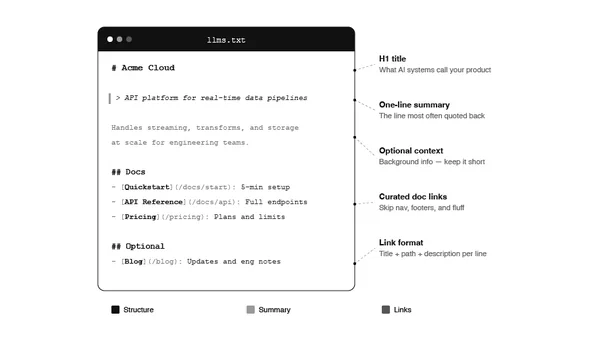
The llms.txt proposal provides a minimal AI-focused site entry point (e.g., AIEWF 2026 uses llms.md at llms.txt) with a structure of H1, blockquote, and H2 sections linking to detail files like llms-full.txt, reducing context clutter. Adoption is mixed—Cursor references it, Google made it a Lighthouse signal—but it's a complement to robots.txt and sitemap.xml, not a replacement.

Upgrade Amazon EKS clusters with confidence using Kubernetes version rollbacks
AI/ML / aws.amazon.com

Upgrade Amazon EKS clusters with confidence using Kubernetes version rollbacks

Amazon EKS now offers Kubernetes version rollbacks, allowing reversal of control plane upgrades (e.g., 1.34 to 1.35) within seven days via a one-minor-version undo. Unlike KEP-4330's emulated versions, EKS restores the previous validated state, with cluster insights flagging compatibility and add-on dependencies. For EKS Auto Mode, rollbacks coordinate node and control plane rollback, respecting pod disruption budgets, with a cancel API to abort node rollbacks.

Build software that heals itself in the agentic era
AI/ML / dev.to

Build software that heals itself in the agentic era

Self-healing software architectures convert failures into structured, PII-free signatures that feed AI agents for automatic fixes. Using their open-source MIME parser mail-parse as example, the pattern ensures never crashing by returning typed diagnostics (e.g., BOUNDARY_NOT_CLOSED) alongside best-effort results. The bottleneck shifts from writing fixes to architecting safe, additive plugin seams that allow agents to apply cumulative repairs without system-level risk.

After spooking Trump into safety testing, Anthropic AI models get global release
AI/ML / arstechnica.com

After spooking Trump into safety testing, Anthropic AI models get global release

The US lifted export curbs on Anthropic's Claude Fable 5 and Mythos 5 after the company implemented stronger safeguards, 24/7 jailbreak monitoring, and expanded red-teaming partnerships with hackers. Mythos 5 remains restricted to cybersecurity researchers via the Glasswing program due to its offensive capabilities, while Fable 5 is globally available. The decision followed Trump administration concerns that these models could be exploited by adversaries to attack US infrastructure.