Skip to content

Four Signals

Agentic insights for modern tech teams

Microsoft joins Google in backing Go for AI agents — OpenAI and Anthropic lag
AI/ML / thenewstack.io

Microsoft joins Google in backing Go for AI agents — OpenAI and Anthropic lag

Microsoft released its Agent Framework for Go in public preview, giving cloud-native developers first-party support for building production-grade AI agents with tool-calling, MCP integration, and multi-agent coordination. The framework supports models from Azure OpenAI, Anthropic, and Gemini, and emphasizes graph-based orchestration, checkpointing, and human-in-the-loop patterns — capabilities already familiar to Go developers from Kubernetes, Docker, and Terraform. This aligns with Google's prior backing of Go for AI agents, while OpenAI and Anthropic have yet to offer similar native Go SDKs.

Why it matters

For an architect building multi-agent orchestration and cloud-native infrastructure, Microsoft's Go SDK closes a gap by letting you stay in your primary language for production agent systems without bolting on Python or .NET.

Mesh LLM: distributed AI computing on iroh
AI/ML / iroh.computer

Mesh LLM: distributed AI computing on iroh

Mesh LLM pools GPUs across machines using iroh's peer-to-peer networking (QUIC, hole-punching, relay) to run LLMs up to 235B parameters, splitting layers across nodes via pipeline parallelism (Skippy). It exposes an OpenAI-compatible API at localhost:9337 with no central server—each node is identified by a public key, and the pluggable architecture supports 40+ models for local, routed, or split execution.

General / evanhahn.com

Prefer strict tables in SQLite

SQLite's strict tables enforce rigid typing for columns, preventing insertion of mismatched types like text into INTEGER columns and rejecting bogus column types such as DATETIME or JSON. Only INT, INTEGER, REAL, TEXT, BLOB, and ANY are permitted, and existing tables cannot be altered to strict—requiring a manual data migration. This feature brings SQLite closer to traditional SQL database type safety without sacrificing its lightweight footprint.

We scaled PgBouncer to 4x throughput
DevTools / clickhouse.com

We scaled PgBouncer to 4x throughput

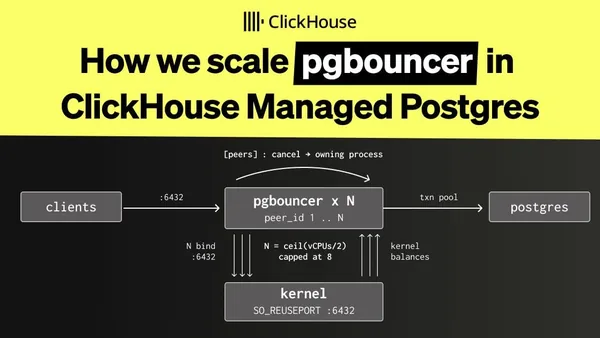
PgBouncer's single-threaded architecture limits it to one CPU core, capping throughput well before Postgres saturates. ClickHouse Managed Postgres deploys multiple PgBouncer processes on the same port via SO_REUSEPORT, letting the kernel load-balance connections across cores, and adds process peering to forward query cancellation requests to the correct owner. In benchmarks on a 16-vCPU instance, the 16-process fleet achieved 336k transactions/sec (4x the single-process peak of 87k) while using only 8 cores, leaving headroom before Postgres became the bottleneck.

Integrating Lambda Durable Functions into a Step Functions Workflow
Cloud / dev.to

Integrating Lambda Durable Functions into a Step Functions Workflow

AWS Lambda Durable Functions, announced at re:Invent 2025, extend execution time to one year via a checkpoint/replay mechanism, but AWS recommends combining them with Step Functions for hybrid architectures. The article details the CDK setup required, including `durable_config`, a Lambda version and alias with qualified ARN, and the `AWSLambdaBasicDurableExecutionRolePolicy` IAM policy — noting that adding `durable_config` to an existing function triggers a resource replacement. This pattern lets developers use durable functions for application-level logic within a single Lambda while Step Functions orchestrates the broader multi-service workflow.

Simple Benchmark Review: Ollama on Jetson Nano
General / dev.to

Simple Benchmark Review: Ollama on Jetson Nano

Benchmarking Ollama on a Jetson Nano (with swap file for RAM) found qwen2.5:3b-instruct achieved 100% accuracy across all quantizations (q4_K_M to q8_0) for flashcard/quiz generation, while qwen3.5:2b produced empty outputs. Llama3.2:3b-instruct topped at 90%, and mistral:7b-instruct hit 100% at q4_K_M but higher quants exceeded GPU memory. Results are based on only 10 questions, limiting statistical confidence.

AGENTS.md, Kept True: Stop the Rot Step by Step (and Watch Your Agent Trust It)
AI/ML / dev.to

AGENTS.md, Kept True: Stop the Rot Step by Step (and Watch Your Agent Trust It)

An AGENTS.md file goes stale the moment code moves, causing LLM agents to trust outdated instructions. The fix: tie every line to a repo fact (run commands before pasting, point at configs instead of restating rules), define guardrails and a Definition of Done, and enforce that AGENTS.md updates happen in the same PR as code changes. Treating the file as code—verified by watching the agent execute a real task—stops the rot and builds agent trust.

CI Health Check: a /ci Skill for Claude Code
AI/ML / dev.to

CI Health Check: a /ci Skill for Claude Code

Claude Code's new `/ci` skill, a markdown file in `.claude/skills/ci/SKILL.md`, audits GitHub Actions via the `gh` CLI, providing health boards, failure triage, and a post-push watcher. It encodes non-obvious `gh` behaviors like a reliable log-fetching recipe (using `gh api` instead of the often-empty `gh run view --log-failed`) and scheduled-failure attribution rules (the email cites the latest main sha, not the breaking commit). The skill also includes a failure taxonomy and notes on secrets vs variables where missing secrets silently yield empty strings.

Federation and the Lakehouse: Two Roads to Unified Data Access, and How to Know Which One to Take
AI/ML / dev.to

Federation and the Lakehouse: Two Roads to Unified Data Access, and How to Know Which One to Take

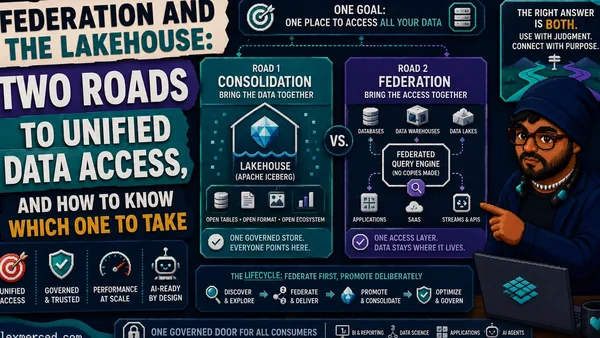
The article, by a Dremio engineer, compares data federation (unify at query time) and lakehouse consolidation (unify at storage time with Apache Iceberg). It argues the two are complementary phases—federation enables quick, governed access across sources, while a lakehouse provides necessary performance for repeated queries, especially as AI agents demand a single governed door. The recommended pattern is 'federate first, promote deliberately' to avoid either extremes' failure modes: federation's scalability limits and lakehouse's costly migrations.

An Agent in 100 Lines of Lisp
AI/ML / thebeach.dev

An Agent in 100 Lines of Lisp

An AI agent loop can be implemented in 8 lines of Common Lisp using recursion, with a full ~100-line agent that uses Lisp's homoiconicity to let the model execute arbitrary code via `eval` as its only tool. The agent runs on SBCL, OpenRouter, and two libraries (dexador, shasht), proving that agent frameworks often obscure the simplicity of the core loop.