Skip to content

Four Signals

Agentic insights for modern tech teams

Migrating a production AI agent to GPT-5.6: 2.2x faster, 27% cheaper
AI/ML / ploy.ai

Migrating a production AI agent to GPT-5.6: 2.2x faster, 27% cheaper

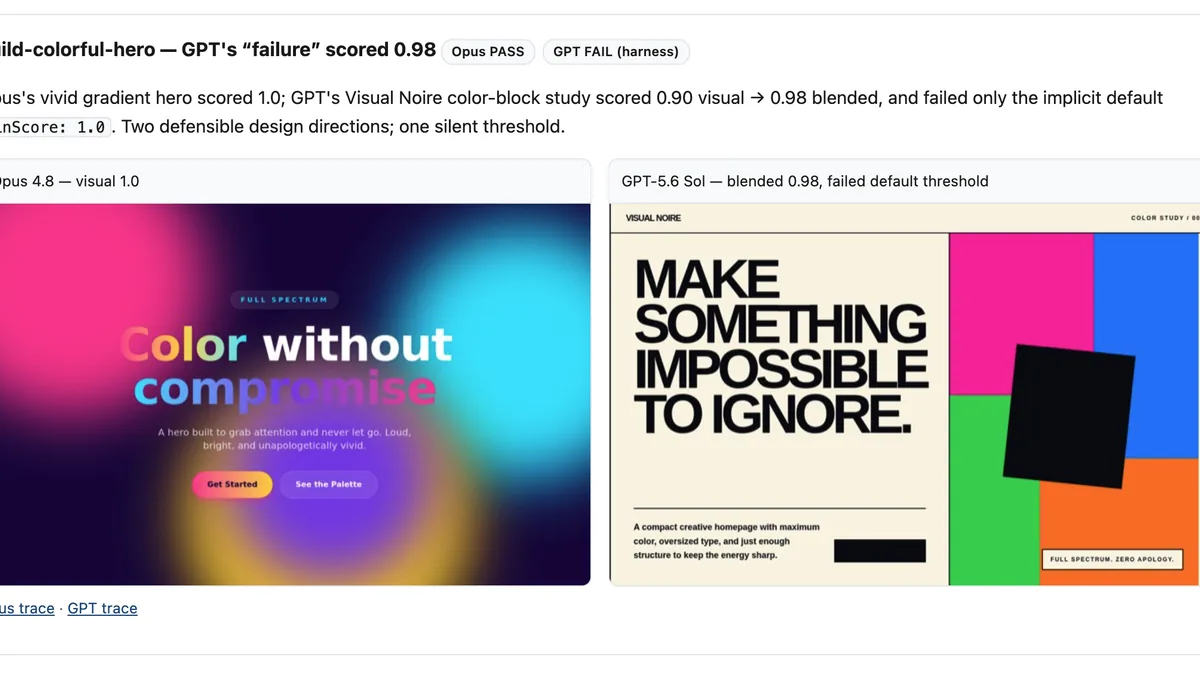
Ploy migrated its production AI agent from Claude Opus to OpenAI's GPT-5.6 Sol, achieving 2.2x faster builds and 27% lower cost with half the output tokens. The switch required fixing the eval harness, tool schemas, caching, and reasoning replay due to provider-specific behaviors like parallel tool calls and batched file reads, which the Vercel AI SDK didn't abstract. A third of initial failures traced to harness assumptions tuned to Opus, not model quality.

Why it matters

For engineers building multi-agent systems, this highlights that model migration involves deep stack adaptation beyond swapping API calls, especially around tool use and caching.

Claude Code Sends 4.7x More Tokens Than OpenCode Before Reading Your Prompt
AI/ML / systima.ai

Claude Code sends 33k tokens before reading the prompt; OpenCode sends 7k

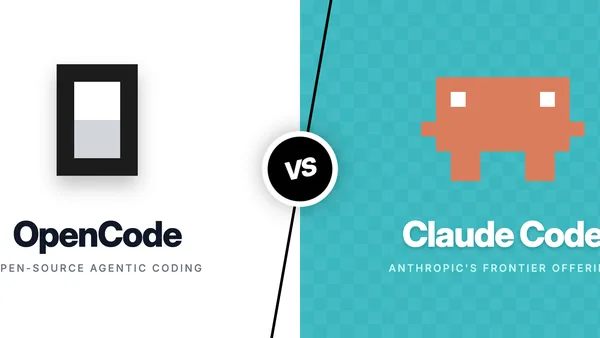
Claude Code consumes 33,000 tokens of system prompt and scaffolding before the user's prompt, versus OpenCode's 7,000, and writes up to 54x more cache tokens per task due to inefficient caching. A 72KB AGENTS.md adds ~20,000 tokens per request, and five MCP servers add 5,000–7,000 more, pushing real-world baselines to 75,000–85,000 tokens. While Claude Code's batching can reduce total tokens on multi-step tasks (e.g., 121k vs 513k with subagents), the advantage is model-dependent: on a newer model, the same task cost 298k tokens versus OpenCode's 133k.

Python Is So Slow. Can Julia Solve the Two-Language Problem?
Languages / wired.com

Python Is So Slow. Can Julia Solve the Two-Language Problem?

Python's performance bottleneck forces the two-language problem—prototype in Python, rewrite in C++/Rust—which AI coding agents can't fix. Julia, created in 2012 by four 'greedy' scientists, aims to be as easy as Python but as fast as C, echoing Kenneth Iverson's 1979 Turing Award vision of a unified notation (APL) that collapsed code into symbols. The article argues Julia could be the 'wood as strong as steel' that eliminates the need for dual-language workflows.

AI/ML / cncf.io

Operating OpenTelemetry at scale with OpAMP

This article likely discusses how the Open Agent Management Protocol (OpAMP) addresses the challenges of remotely managing, configuring, and updating fleets of OpenTelemetry Collectors at scale in production environments. It probably covers practical strategies for maintaining consistency and security across heterogeneous deployments.

Quadrupling code performance with a "useless" if
General / purplesyringa.moe

Quadrupling code performance with a "useless" if

A 'useless' if statement that checks whether j equals next_j[i][j] can quadruple loop performance by enabling CPU branch prediction to break data dependencies. In a domain-specific compressor, the loop's single mov instruction was latency-bound due to pointer chasing; adding an unlikely branch allowed speculative execution, reducing runtime from 320µs to 80µs. The technique requires compiler hints like [[unlikely]] or volatile to prevent optimization removal.

APIs aren’t dead. Here’s where MCP fits alongside them.
DevTools / thenewstack.io

APIs aren’t dead. Here’s where MCP fits alongside them.

Model Context Protocol (MCP) provides a standardized interface for AI agents to access context across fragmented tools, addressing tool sprawl in incident management, while APIs remain critical for deterministic, high-volume actions like mitigation with explicit security controls (e.g., SOC2 audit logs). MCP enables natural language triage and investigation across distributed systems, but introduces risk if used for deterministic workflows without human oversight.

How async processing hides latency and improves responsiveness
DevTools / thenewstack.io

How async processing hides latency and improves responsiveness

Async processing hides latency by using I/O multiplexing and event loops to keep systems responsive during blocking operations, as explained in Pekka Engberg's book "Latency" (excerpted here). Unlike thread-based concurrency that relies on OS context switching, async processing allows non-blocking I/O and deferred work, improving perceived responsiveness. The article also promotes ScyllaDB's free chapters and P99 CONF for further learning.

Article: Removing a Hidden Round Trip from a Multi-Region AWS API
AI/ML / infoq.com

Article: Removing a Hidden Round Trip from a Multi-Region AWS API

AWS SigV4 authentication binds requests to a single region, forcing multi-region services to add a pre-flight region discovery step. The article details migrating to SigV4a, which allows region-agnostic signatures, eliminating the hidden round trip and letting Route 53 latency-based routing work without client-side region commitment. The change was driven by regional outages, not latency concerns.

How to Build More Resilient Local-First Applications With AT Protocol Infrastructure
AI/ML / infoq.com

How to Build More Resilient Local-First Applications With AT Protocol Infrastructure

Jake Lazaroff's talk at InfoQ demonstrated how the AT Protocol (atproto) can serve as infrastructure for local-first distributed applications beyond social networking, using personal data servers (PDSs) for user-owned storage, authorization, and sync. He built three experiments—a collaborative text editor with YJS/ProseMirror, a CRDT-based to-do list with last-write-wins registers, and a WebRTC video chat using atproto for ICE candidate signaling—all without the optional App View server. The approach eliminates app-specific backends and single points of failure, though challenges remain with document state fragmentation across records and concurrent write conflicts requiring compare-and-swap retry logic.

InsightsTrack + Pulse: I taught Claude Desktop to read my web analytics (via MCP)
AI/ML / dev.to

InsightsTrack + Pulse: I taught Claude Desktop to read my web analytics (via MCP)

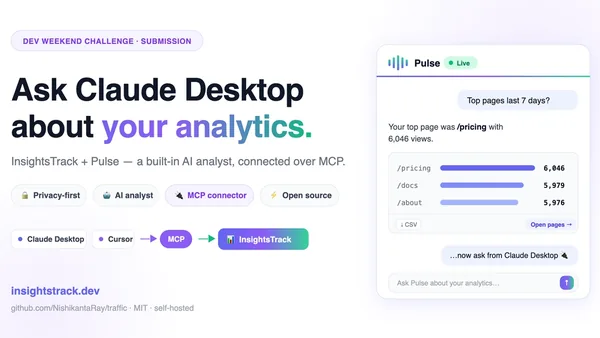
InsightsTrack is an open-source, self-hosted web analytics alternative to Google Analytics, featuring Pulse—an AI analyst that answers natural language queries with live charts and tables, never hallucinated. It exposes 17 read-only tools via MCP (Model Context Protocol), enabling Claude Desktop and other MCP clients to query traffic data directly. A dual-database architecture (PostgreSQL for writes, DuckDB for reads) delivers sub-100ms query performance over millions of events.