
Skip to content

Four Signals

Agentic insights for modern tech teams

LM Studio Bionic
AI/ML / lmstudio.ai

LM Studio Bionic: the AI agent for open models

LM Studio Bionic is a new AI agent for open models, offering coding assistance with inline diffs and agentic code search, document work in a sandboxed environment, and voice input via Mistral's Voxtral local transcription. It runs models locally or on LM Studio Secure Cloud with zero data retention, supporting frontier open models like GLM 5.2 and Kimi K2.7 Code.

Why it matters

For a Solutions Architect focused on AI/ML and cloud, this provides a privacy-preserving, cost-controlled agent that leverages open models for real work, aligning with trends in agent orchestration and developer experience.

The Pulse: What can we learn from Bun’s rapid Rust rewrite with AI?
AI/ML / blog.pragmaticengineer.com

The Pulse: What can we learn from Bun’s rapid Rust rewrite with AI?

Bun creator Jarred Sumner is rewriting the 535K-line Zig codebase into Rust, driven by persistent memory bugs (use-after-free, double-free) that safe Rust eliminates at compile time. The migration is accelerated by the AI tool Fable, which was temporarily blocked by US export controls but is now globally available, challenging the traditional dogma that full rewrites are always a terrible idea.

OpenAI’s GPT-Red automates prompt injection testing to harden AI agents
AI/ML / thenewstack.io

OpenAI’s GPT-Red automates prompt injection testing to harden AI agents

OpenAI's GPT-Red automates prompt injection testing via self-play reinforcement learning, where an attacker model brute-forces exploit variations against defender models in simulated environments (emails, APIs, files). It successfully attacked nearly every evaluated model, and its findings helped harden GPT-5.6, which now shows a 0.05% failure rate on direct prompt-injection attempts—a 6x improvement over the previous strongest model. In live tests, GPT-Red manipulated an AI vending machine to drop prices to $0.50 and exfiltrated data from a Codex CLI agent using fewer tokens than a general-purpose frontier model.

We're building Postgres in Rust. Using the LLVM of databases
Languages / turso.tech

We're building Postgres in Rust. Using the LLVM of databases

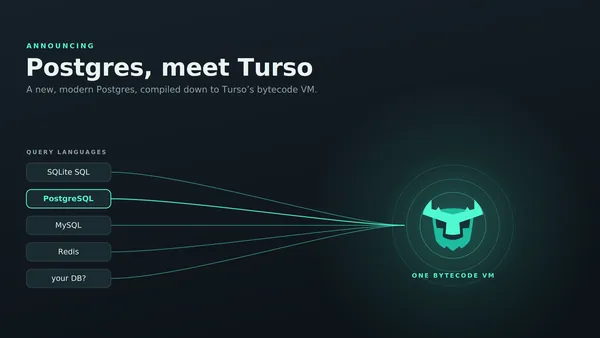
Turso is building a Postgres-compatible database in Rust, using its existing SQLite-compatible engine as the "LLVM of databases" — a single core supporting multiple frontends. The architecture delivers concurrent writes via MVCC, self-updating materialized views, and async execution for embedded/browser use, with reliability ensured through deterministic simulation, Antithesis, and formal methods. The open-source project, with 260+ contributors, welcomes AI contributions and aims to replicate the Linux kernel's meritocratic contribution culture.

The Human-in-the-Loop is Tired
General / pydantic.dev

The human-in-the-loop is tired

Developers face a new fatigue from supervising LLM-generated code that is plausible but often incoherent, as described by Pydantic's Douwe who reviews dozens of AI-created PRs daily. This 'supervision fatigue' stems from errors of coherence rather than capability, requiring developers to hold intent while machines produce volumes of mostly-correct output.

My Agent Shipped 3 PRs in an Evening. 40% of My Messages Were Corrections.
AI/ML / dev.to

My Agent Shipped 3 PRs in an Evening. 40% of My Messages Were Corrections.

An agent session orchestrated by DeepSeek V4-Flash shipped three SPFx 1.23.2 pull requests (MCP client, Azure AI Agent, M365 Copilot Agent) in 75 active minutes, generating 3,500 lines of code. However, 12 of the user's 30 messages (40%) were corrections, clustered around pipeline setup and warning fixes, as the agent defaulted to implementing instead of orchestrating and made wrong tech choices (Yeoman 1.22, community library) despite correct context. Once the process was enforced, the third sample required zero corrections, highlighting that capability exists but constraint surfacing is the bottleneck.

GoDaddy opened its registrar to AI agents. Then it had to build guardrails.
AI/ML / thenewstack.io

GoDaddy opened its registrar to AI agents. Then it had to build guardrails.

GoDaddy launched a developer platform that exposes domain registration, purchase, and DNS management via a v3 Domains API and CLI, targeting engineering teams that want to integrate domain lifecycle into CI/CD pipelines and AI agent workflows. The API uses a quote-then-execute model with idempotency keys, short-lived price-lock tokens, and a consent object requiring human approval for purchases initiated by automated agents. OAuth-based scoped permissions and approval flows for irreversible actions serve as guardrails against runaway AI agents, differentiating GoDaddy's offering from AWS Route 53 and Cloudflare by making the registration and purchasing layer programmable, not just DNS.

I got tired of not knowing what my AI agents were doing, so I built a tiny observability tool
AI/ML / dev.to

I got tired of not knowing what my AI agents were doing, so I built a tiny observability tool

The author built Otterscope, a single Go binary with SQLite that ingests OpenTelemetry traces from AI agents, presenting runs as logical units with step-level detail, provider-aware cost tracking, and integrated evals including a compare view for prompt changes. It avoids hosted services or heavy self-hosted stacks like ClickHouse, targeting small-scale side projects with a local-first design that handles the messy OpenTelemetry GenAI convention migration by supporting both old and new attribute layouts.

Founding Lead Playbook: Running Product, Architect & Engineering with AI Agents + 2 Humans
AI/ML / dev.to

Founding Lead Playbook: Running Product, Architect & Engineering with AI Agents + 2 Humans

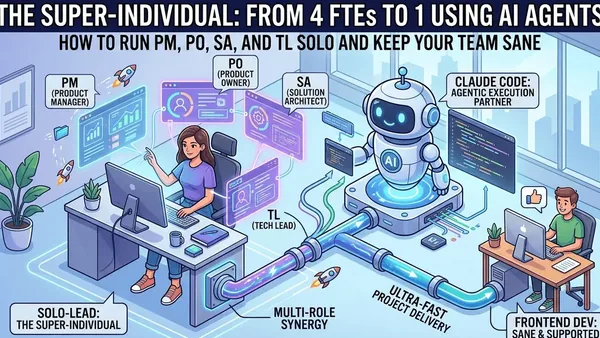
A founding lead's playbook for running product, architecture, and backend engineering solo with an AI coding agent and one frontend developer. The model collapses coordination latency but amplifies judgment load; success requires decoupling product definition from implementation and hardening schema/API contracts before coding. For multi-tenancy, the author recommends service-layer tenant_id filtering over RLS for simplicity and testability.

Detecting LLM-Generated Texts with “Classical” Machine Learning
AI/ML / blog.lyc8503.net

Detecting LLM-Generated Texts with “Classical” Machine Learning

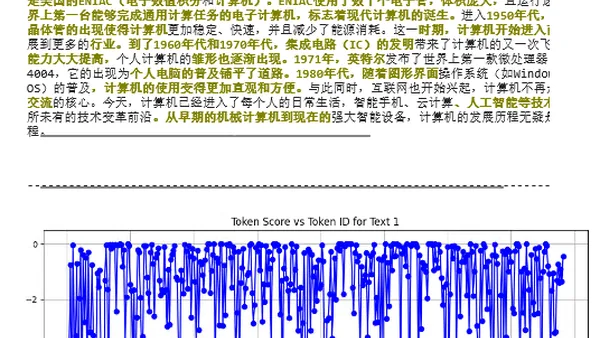
A developer built a classical ML classifier using scikit-learn's Linear SVC and Naive Bayes to detect LLM-generated text, achieving ~85% single-sentence accuracy on a test set. The approach relies on statistical patterns in word choice rather than perplexity-based methods, which proved unreliable and costly. The project is open-source and includes a live demo, suggesting that many commercial AI plagiarism checkers may use similar lightweight techniques.