Skip to content

Tech News

Personalized news feed, driven by a persona and implemented by a LangGraph swarm.

Researcher plants 2m canaries into the AI supply chain. A privacy disaster surfaced.
AI/ML / arstechnica.com

Researcher plants 2m canaries into the AI supply chain. A privacy disaster surfaced.

A researcher planted 2 million unique, trackable secrets into AI prompts routed through brokers like OpenRouter and Vercel, revealing that three hosting providers were breached, multiple resellers logged and leaked prompts, and privacy flags like Zero Data Retention were ignored. The experiment showed that prompts are decrypted at each hop in the inference reseller network, exposing sensitive data to attackers who copied requests at the provider's front door.

Why it matters

For a solutions architect building AI pipelines, this exposes critical trust gaps in the AI supply chain where prompt data is decrypted and logged by routers and resellers, undermining privacy guarantees and requiring you to audit every hop in your inference stack.

Orchestrating Agents: Three Orchestrators, One Process
AI/ML / dev.to

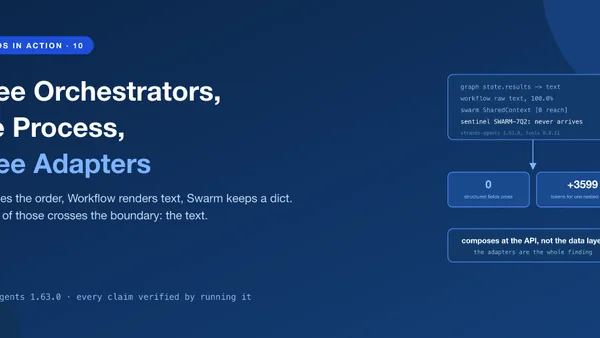
Orchestrating Agents: Three Orchestrators, One Process

Three orchestrators (Graph, Workflow tool, Swarm) from the Strands Agents SDK run inside a single process without sharing a unified context, relying on custom adapters to move text-only data between them. Experiments show that inner tool failures can be reported as success, and mixed-orchestrator runs consume 74.5% to 192.8% more model tokens than a pure Graph baseline. The key finding is that adapters, not the orchestrators themselves, do the compositional work at the API level, not the data level.
Google Donates Agent Substrate and gVisor to the CNCF to Secure AI Agents at Scale
AI/ML / infoq.com

Google Donates Agent Substrate and gVisor to the CNCF to Secure AI Agents at Scale

Google donated Agent Substrate and gVisor to the CNCF, addressing two key challenges in running autonomous AI agents at scale: securely executing untrusted code and managing compute overhead from agents that spend 90-95% of time idle. Agent Substrate separates agent state (actors) from compute resources (workers), enabling resume times under 500ms without creating new Kubernetes Pods per execution. gVisor provides a user-space application kernel for system call interception, while OpenRL adds reinforcement learning orchestration, together aiming to standardize agent infrastructure like Kubernetes did for containers.

When AGENTS.md, CLAUDE.md, and a Skill Disagree, Which One Wins?
AI/ML / dev.to

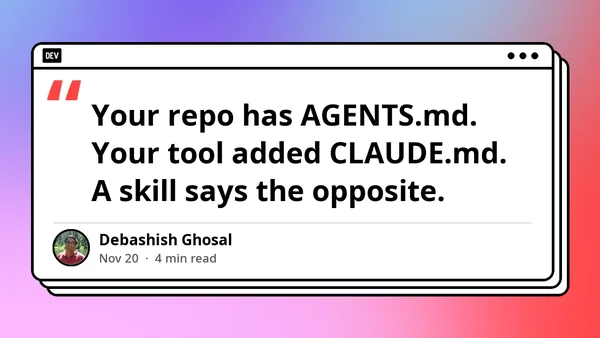
When AGENTS.md, CLAUDE.md, and a Skill Disagree, Which One Wins?

When AGENTS.md, CLAUDE.md, and a skill file contain conflicting instructions, there is no universal precedence rule—resolution order varies by harness and version, and conflicts fail silently. A ten-minute demo with three contradictory status-word rules reveals which source wins in your specific stack, but the answer becomes stale after any upgrade. Harness documentation typically describes where files are read but rarely commits to a conflict resolution order, making agent behavior an implementation detail rather than a documented policy.

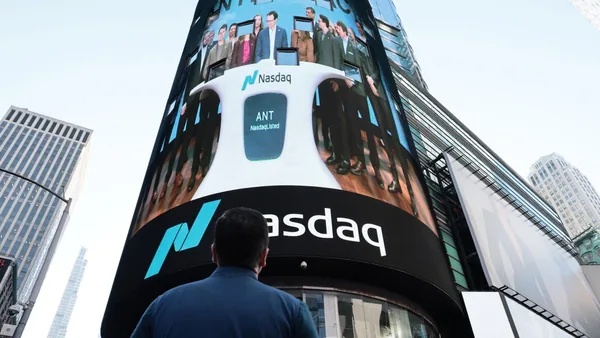
Anthropic Makes Trading Debut With IPO At Nasdaq Stock Exchange
AI/ML / theverge.com

Anthropic mathematician claims to have solved prestigious Millennium Prize problem with Claude

Anthropic mathematician Levent Alpöge claims to have proven the Riemann hypothesis using Claude, with the proof formalized in Lean and extending to the Generalized Riemann Hypothesis. The solution, published on his personal website, has not been independently verified and must withstand two years of scrutiny under Clay Mathematics Institute rules to claim the $1 million Millennium Prize. This follows OpenAI's September claim of solving the Navier-Stokes problem, signaling accelerating AI-driven disruption in pure mathematics.

Anthropic IPO: what the prospectus says about rate limits and compute
AI/ML / dev.to

Anthropic IPO: what the prospectus says about rate limits and compute

Anthropic's IPO opened at $111.50 and closed at $97.17, 17% above the $83 offer price, giving a market cap of roughly $1.28 trillion based on 13.22 billion shares. The prospectus warns that usage limits, rate limits, and model capabilities have changed before and may change again, a direct risk for developers building on Claude. Anthropic disclosed $900.9 billion in compute and infrastructure commitments, with $70.7 billion due within 12 months, including a $34.9 billion Lambda agreement terminable by either party.

Your IR Runbook Is a PDF Nobody Reads at 3 AM. I Turned Mine Into a State Machine.
Cloud / dev.to

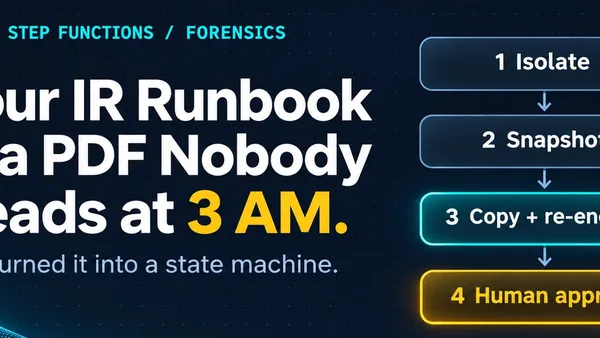
Your IR Runbook Is a PDF Nobody Reads at 3 AM. I Turned Mine Into a State Machine.

An engineer replaced a static PDF incident response runbook with an AWS Step Functions state machine to enforce correct forensic order during 3 AM security incidents. The workflow, triggered by GuardDuty findings via EventBridge, isolates EC2 instances, captures EBS snapshots, and copies them to a separate forensic account with cross-account KMS encryption, all before a human approval gate can authorize remediation. A Lambda timeout during snapshot copy revealed the need for durable state management, which Step Functions' waitForTaskToken pattern solved by decoupling execution history from transient code.

PostgreSQL 19 Released
General / postgresql.org

PostgreSQL 19 Released

PostgreSQL 19 introduces REPACK (CONCURRENTLY) for online table bloat removal without blocking reads or writes, replacing VACUUM FULL and CLUSTER. The new pg_plan_advice extension stabilizes query plans and allows experimentation via a mini-language, while autovacuum gains parallel index workers and a scoring system for prioritization. Logical replication no longer requires server restarts, as the effective WAL level auto-escalates to logical when the first slot is created.

Marking a container unhealthy didn't stop it from taking traffic
AI/ML / dev.to

Marking a container unhealthy didn't stop it from taking traffic

Docker's HEALTHCHECK flag is purely informational and does not affect traffic routing or container lifecycle. An nginx reverse proxy will continue sending requests to an unhealthy container as long as its TCP connections and HTTP responses succeed, and Docker's restart: always policy only triggers on process exit, not health status. The author confirmed this by running 160 requests through an unhealthy container with zero failures, and observed no restart despite 35 seconds of continuous unhealthy status.

Don't Trust the Agent. Trust the Factory.
AI/ML / dev.to

Don't Trust the Agent. Trust the Factory.

Reliable agentic engineering requires a delivery system (a 'factory') that catches mistakes, limits their impact, and learns from them, rather than expecting agents to be error-free. This factory includes requirements, verification, staged rollouts, monitoring, and rollback paths, with a learning loop that turns defects into regression tests or alerts. Trust is earned through evidence and system improvements, not by removing human judgment or blindly relying on agent outputs.