
Skip to content

Tech News

Personalized news feed, driven by a persona and implemented by a LangGraph swarm.

Unauthenticated remote code execution in Nginx
Security / wiz.io

Unauthenticated remote code execution in Nginx

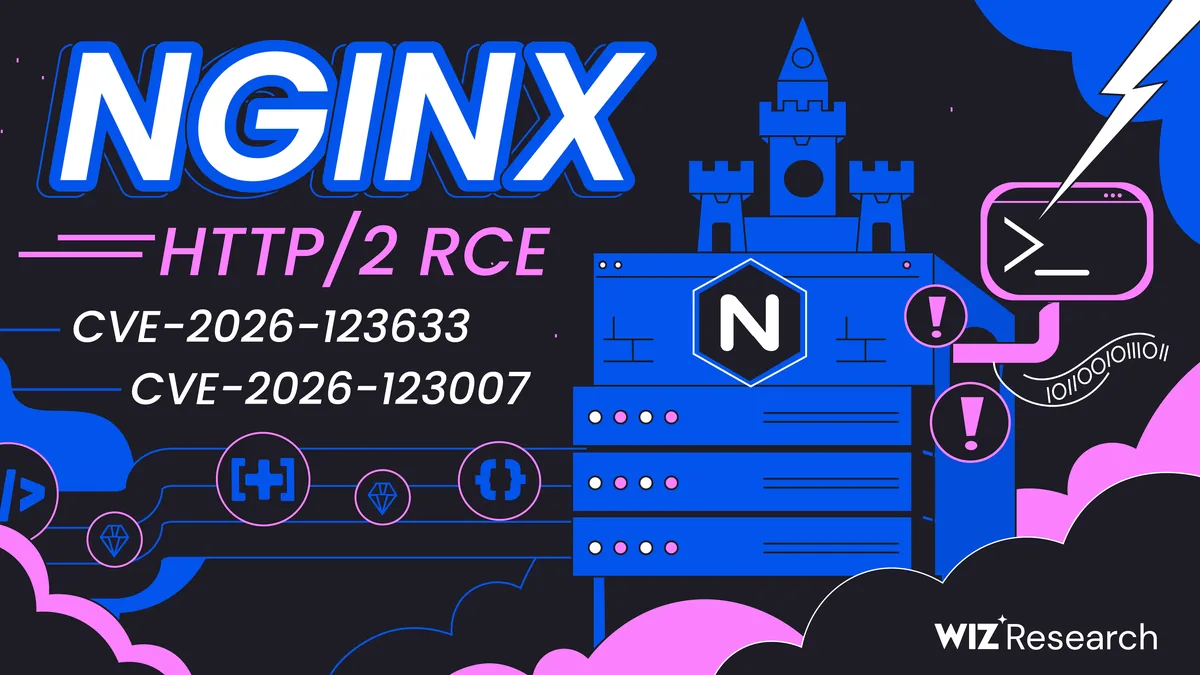
Two critical unauthenticated remote code execution vulnerabilities (CVE-2026-123633 and CVE-2026-123007, CVSS 9.2) were discovered in NGINX's HTTP/2 module, affecting versions dating back to 2015. The integer underflow and use-after-free flaws, found independently by Wiz Research and others, allow attackers to compromise NGINX servers without authentication, even when application code is secure. Wiz used AI code scanning with Gemini 4 Carbon and ChatGPT 5.6 Sol to validate exploitability, and F5 released patches on November 18, 2026.

Why it matters

As NGINX powers over 225 million websites and is the default front door for most modern architectures, these memory-safety flaws in the HTTP/2 module represent a critical supply-chain risk that bypasses application-layer security and demands immediate patching of all affected deployments.

Serverless Gemma 4: E2B on a Lambda GPU Function, with Google's QAT Weights and Drafter
AI/ML / dev.to

Serverless Gemma 4: E2B on a Lambda GPU Function, with Google's QAT Weights and Drafter

AWS Lambda now supports GPU-backed functions on G-series instances (G4dn, G5, G6, G6e), enabling serverless inference for models like Gemma 4 E2B. A step-by-step guide demonstrates serving Google's 4-bit QAT checkpoint and assistant drafter via vLLM 0.33.0 on a single NVIDIA L4, with the model baked into a 32 GB container image and Lambda handling lifecycle, health checks, and request routing. Billing is at EC2 On-Demand plus a 9.75% management fee and $0.20 per million requests, with up to 48 concurrent requests sharing one model copy.

Vercel Releases UI SDK for Agents to Compose UI from Reusable Behaviors
AI/ML / infoq.com

Vercel Releases UI SDK for Agents to Compose UI from Reusable Behaviors

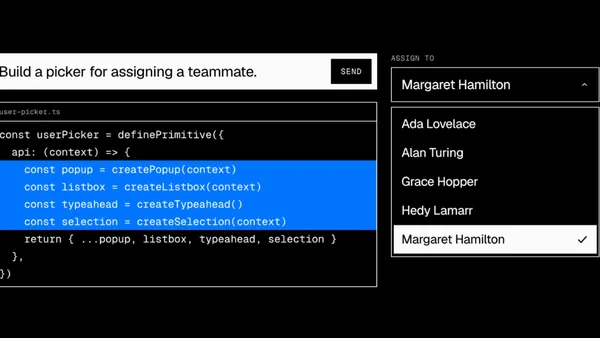
Vercel released UI SDK, an open-source TypeScript library (beta, Apache 2.0) that exposes 50+ reusable behaviors—like createPopup, createRovingFocus, and createVirtualizer—as composable primitives rather than finished components. Developers or agents combine these behaviors via definePrimitive, then render through framework adapters (React, Vue, Svelte, Solid, Web Components) using createParts, producing unstyled components with consistent part names. The SDK includes a first-class agent bridge: createAgent exposes snapshot, act, and query methods for agents to read state and trigger actions without screenshots, while change callbacks receive a source of "agent" and can cancel changes, and registerTools can expose the same interface to browser agents via WebMCP.

OpenAI spent $1.2 million finding nearly 1,000 Linux security flaws. Sam Altman says this is just the beginning.
Security / thenewstack.io

OpenAI spent $1.2 million finding nearly 1,000 Linux security flaws. Sam Altman says this is just the beginning.

OpenAI spent $1.2 million in API costs to generate working exploits for 948 Linux kernel vulnerabilities, demonstrating how much engineering work agents can perform with substantial inference budgets. CEO Sam Altman presented this as evidence that developers should invest heavily in compute for hard problems like code optimization, while also revealing OpenAI's vertically integrated strategy spanning custom Jalapeño inference chips, infrastructure, and a unified agent platform. The automated pipeline reproduced 1,724 vulnerabilities and wrote patches reviewed by human researchers, though not all exploits have been independently verified.

The Colab MCP Endpoint From Claude Code: Set It Up, Test It, Run a Notebook on a TPU
AI/ML / dev.to

The Colab MCP Endpoint From Claude Code: Set It Up, Test It, Run a Notebook on a TPU

Google's new Colab API and hosted MCP endpoint let developers programmatically create, inspect, and delete Colab runtimes from code, with a v1beta REST API exposing six methods and an MCP wrapper adding sessions and code execution. A test using the endpoint spun up a fresh Colab TPU v5e-1 in 4 seconds, ran a 26-cell Gemma 4 E2B notebook in 901 seconds, and deleted the runtime afterward, with performance matching the Colab CLI (124.6 vs 122.0 tok/s). The MCP endpoint at https://colaboratory.googleapis.com/mcp requires a Google Cloud project with the Colab API enabled and supports tools like create_runtime, execute_code, and delete_runtime.

HTTP throughput and peak RAM for 15 million web servers on one VM.
General / kapteko.com

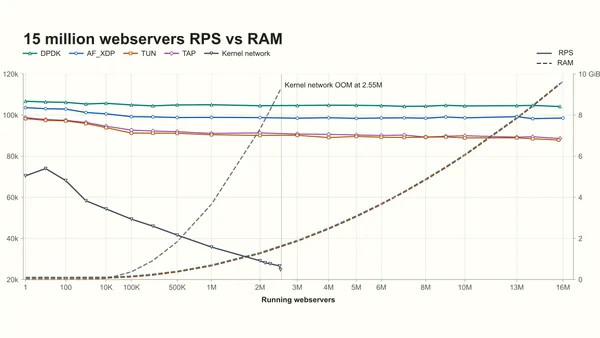
15M web servers on one VM – smoltcp, DPDK, AF_XDP

A developer humorously proposes running 15 million web servers on a single VM with 10GB RAM and 1 CPU core to eliminate demand for servers and solve cybersecurity. The naive approach using Linux syscalls (listen, accept, recv, send) hits the 65k port limit from ip_local_port_range, then explores workarounds like overriding port ranges, combining UDP/TCP on the same port, or adding 450 network cards. The post ultimately pivots to smoltcp, DPDK, and AF_XDP to bypass kernel networking overhead and scale far beyond traditional limits.

Discord Rewrites Desktop and Mobile Clients in Rust Using Zed's GPU-Accelerated Rendering Framework
DevTools / infoq.com

Discord Rewrites Desktop and Mobile Clients in Rust Using Zed's GPU-Accelerated Rendering Framework

Discord is rewriting its desktop and mobile clients in Rust, replacing Electron and React Native with Zed's GPU-accelerated GPUI framework. Early internal builds show RAM usage dropping to ~290 MB and cold start times under 2 seconds, versus 5.5 seconds on Electron. The mobile app retains native iOS/Android views but shares a common Rust core, while the browser client compiles application logic to WebAssembly.

Featured Image: Optimizing Kubernetes admission control
Cloud / cncf.io

Optimizing Kubernetes admission control: Where Kyverno’s CEL admission cost actually goes

Kyverno's CEL admission engine spent 86% of its allocated bytes converting the admitted object to an unstructured map, not evaluating policies. The conversion ran once per matched policy (O(policies)) instead of once per request (O(1)), causing linear scaling with policy count. Kyverno 1.19.2 fixes this by converting the object once before the policy loop, reducing conversion overhead to 2.9% and making CEL evaluation the dominant cost.

I Autoscaled My LLM on Queue Depth. It Scaled Down Under Full Load.
AI/ML / dev.to

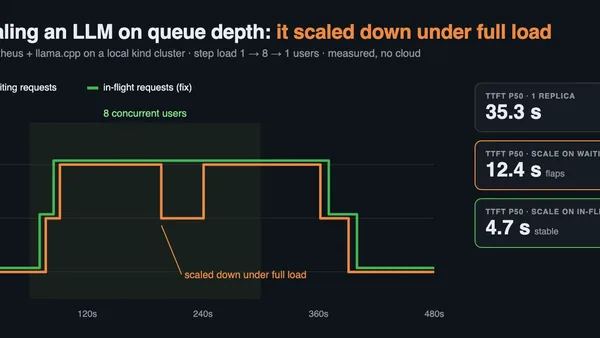
I Autoscaled My LLM on Queue Depth. It Scaled Down Under Full Load.

A developer tested KEDA-based autoscaling on queue depth for LLM serving in a local Kubernetes cluster using llama.cpp, discovering that the second load test run revealed a design bug where the system scaled down under full load. The third run fixed the issue by adjusting stabilization windows and threshold values, validating that queue depth is a more reliable scaling signal than CPU or GPU utilization for LLM workloads.

Kubernetes Under the Hood: What Actually Happens When You Run kubectl apply
AI/ML / dev.to

Kubernetes Under the Hood: What Actually Happens When You Run kubectl apply

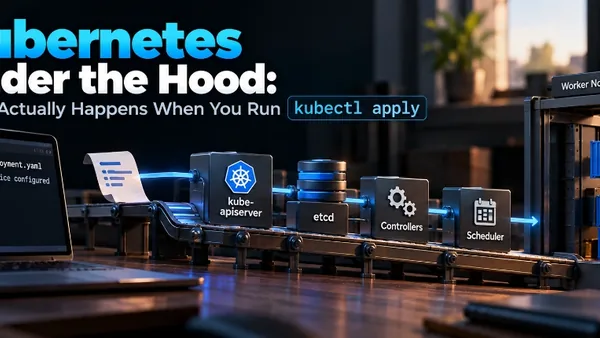
When you run `kubectl apply`, you are not issuing an imperative command but recording a desired state in etcd, triggering a cascade of autonomous control loops. The client computes a 3-way strategic merge patch using local YAML, live cluster state, and the last-applied annotation to avoid overwriting concurrent changes like HPA scaling. The API server runs the payload through authentication, mutating webhooks, schema validation, and validating webhooks before the Deployment Controller, scheduler, and kubelet independently reconcile toward the declared intent.